Games for two to six players, where everyone gets a turn every minute or two: word games, dice and card games, pencil games and games for a small dinner.
Start with this one
Ghost
Players
2 to 6, best with 3
Minutes
10 to 15
Ages
9 and up
You need
Nothing
The first player says a letter.
Each player in turn adds one letter to the end, keeping a real word possible but trying not to finish one.
A player who completes a word of four or more letters loses the round.
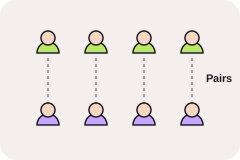
Suggested setup: pairs. Before the game, partners agree on a secret signal, such as a wink or a tap of the ear.
Before the game, partners agree on a secret signal, such as a wink or a tap of the ear.
Deal four cards to each player and four face up in the middle.
Everyone swaps cards with the middle, one at a time, trying to collect four of a kind. When nobody wants the middle cards, the dealer deals four new ones.
A player with four of a kind gives their partner the signal. The partner calls 'Kemps' and the pair scores a point.
If an opponent spots the signal first, they call 'Stop Kemps' and their pair scores instead.
Contact
Players
3 to 8
Minutes
15 to 20
Ages
10 and up
You need
Nothing
Suggested setup: spread out. One player, the keeper, thinks of a word and says its first letter, such as P.
One player, the keeper, thinks of a word and says its first letter, such as P.
Another player thinks of any word starting with P and gives a clue to it, such as 'a bird that can talk' for parrot.
Another guesser who knows the answer says 'contact'. Both count down from three and say the word together.
If the keeper names the clue word before the countdown ends, the contact fails. If the two guessers match, the keeper reveals the next letter of their word.
Guessers keep going until someone names the keeper's word, and that player becomes the next keeper.
Liar's dice
Players
2 to 6
Minutes
15 to 30
Ages
10 and up
You need
Five dice and a cup for each player
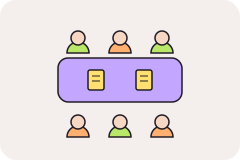
Suggested setup: tables. Everyone shakes five dice under their cup and looks at their own dice only.
Everyone shakes five dice under their cup and looks at their own dice only.
The first player bids on how many dice of one face are on the whole table, such as 'three fours'.
Each next player must raise the bid, with more dice or a higher face, or call 'liar'.
On a call, everyone lifts their cup. If the bid was true, the caller loses a die; if not, the bidder does.
A player with no dice left is out. The last player with dice wins.
The dictionary game
Players
3 to 8
Minutes
20 to 30
Ages
12 and up
You need
A dictionary, slips of paper and pens
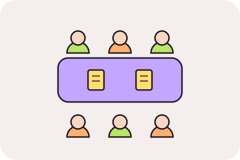
Suggested setup: tables. The reader finds an unusual word in the dictionary, says it and spells it.
The reader finds an unusual word in the dictionary, says it and spells it.
Everyone else writes a made-up definition that sounds real. The reader copies the true one onto a slip.
The reader collects and shuffles the slips, then reads them all aloud.
Players vote for the definition they think is real. A right vote scores 2 points, and each vote for your made-up definition scores you 1.
Pass the dictionary to the next reader.
Consequences
Players
3 to 8
Minutes
10 to 15
Ages
8 and up
You need
A long strip of paper and a pen for each player
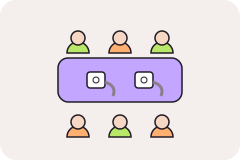
Suggested setup: tables. Each player writes a character's name at the top of their strip, folds it over to hide it and passes it on.
Each player writes a character's name at the top of their strip, folds it over to hide it and passes it on.
On the strip they receive, each player adds who the character met, then folds and passes again.
Continue with where they met, what the first one said, what the other replied and what happened next.
Unfold the strips and read the stories aloud.
Story dice
Players
2 to 6
Minutes
10 to 15
Ages
6 and up
You need
A set of printed and folded story dice
Suggested setup: spread out. Roll all the story dice.
Roll all the story dice.
The first player starts a story that uses the picture on one die.
Each player in turn adds a sentence using another die, until every die is used.
Roll again for a new story, starting with the next player.
Without a printer: Write 12 story words on slips, such as key, storm and dragon, and draw them from a cup instead of rolling.
Suggested setup: tables. Agree on six categories, such as a food, a country, a job, an animal, a film and something in a kitchen.
Agree on six categories, such as a food, a country, a job, an animal, a film and something in a kitchen.
Pick a letter by opening a book at random and pointing at a word. Skip Q, X and Z.
Everyone writes one answer per category starting with that letter, within two minutes.
Read the answers aloud. An answer nobody else wrote scores a point; a shared answer scores nothing.
Play five letters and add up the points.
Dinner table games
Two truths and a lie at dinner
Players
3 to 8
Minutes
15 to 20
Ages
10 and up
You need
Nothing
Suggested setup: circle. Each guest thinks of two true things about themselves and one invented thing, such as three jobs they have had or three places they have been.
Each guest thinks of two true things about themselves and one invented thing, such as three jobs they have had or three places they have been.
Going around the table, each guest says their three.
The others ask up to three questions, then vote.
The guest reveals the invented one, then tells the story behind a true one.