17 online party games for a video call Quiz, guessing, drawing and scavenger games for any video call, with nothing to install.
Start with this one
Shared-screen quiz board
Players 3 to 20, in two to four teams
Minutes 30 to 45
Ages 10 and up
You need A laptop that can share its screen, and 25 questions in five categories Build the board in the quiz board maker before the call, with harder questions worth more points. Share your screen so everyone sees the board. Teams take turns choosing a category and a value, talk it over, and give one answer by voice. All the steps and ways to adapt it Or try Chat countdown trivia or Survey game on a call .
Find a game
Your group Any size 17 2 to 5 14 6 to 12 17 13 to 30 17 More than 30 4 Time Any length 17 10 minutes or less 7 10 to 20 minutes 11 20 to 40 minutes 6 Longer 1 Runs alongside the party 1 Printer Any 17 No printer 2 Printer available 17
Show every game Group size, playing time and ages are suggestions to adapt to your group, not measurements. Anyone may pass a turn.
Quiz games Shared-screen quiz board
Players 3 to 20, in two to four teams
Minutes 30 to 45
Ages 10 and up
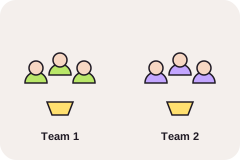
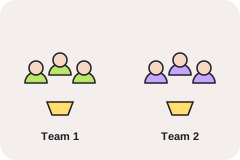
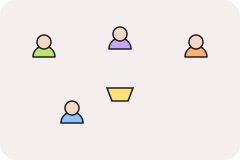
You need A laptop that can share its screen, and 25 questions in five categories Suggested setup: teams. Build the board in the quiz board maker before the call, with harder questions worth more points. Build the board in the quiz board maker before the call, with harder questions worth more points. Share your screen so everyone sees the board. Teams take turns choosing a category and a value, talk it over, and give one answer by voice. Reveal the answer and let the board keep the score. For more than eight players, send teams to breakout rooms to agree on an answer, then bring them back. Chat countdown trivia
Players 4 to 50
Minutes 20 to 40
Ages 10 and up
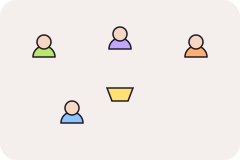
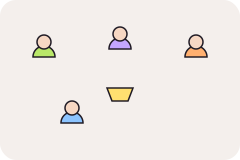
You need A set of trivia questions and the call's chat Suggested setup: spread out. Read a question aloud and show it on screen. Read a question aloud and show it on screen. Players type their answer in the chat but wait to press send. Count down from three. Everyone sends at once, so nobody can copy. Read out who got it right and keep the scores in a notes window. Survey game on a call
Players 6 to 20, in two teams
Minutes 20 to 30
Ages 10 and up
You need Prompts with ranked answers, and a shared document or a notepad for the host Suggested setup: teams. Split the call into two teams and post each team's players in the chat. Split the call into two teams and post each team's players in the chat. Read a prompt, such as 'Name something taken on a train trip'. Team members answer in turn, each naming the next teammate to speak. Reveal each answer as it is named, on the shared document or by reading it out. Three misses hand the other team one chance to steal the points. For this game: Survey game questions and answers
Talking and guessing games Two truths and a lie on a call
Players 4 to 20
Minutes 15 to 20
Ages 10 and up
You need Nothing Suggested setup: spread out. Each player prepares three short statements about themselves: two true, one made up. Each player prepares three short statements about themselves: two true, one made up. In turn, a player says them aloud. Everyone votes in the chat or with a reaction for the one they think is the lie. The player reveals it. Each right vote scores a point, and the player scores one for each person fooled. For this game: Two truths and a lie ideas
Would you rather with thumbs
Players 4 to 50
Minutes 10 to 15
Ages All ages
You need A list of would you rather questions Suggested setup: spread out. Read a question with two options. Read a question with two options. Players hold a thumb up for the first option or a thumb down for the second. Ask one player from each side to explain their pick. On a big call, use a poll or the chat so everyone can be counted. For this game: Funny would you rather questions
Word association chain
Players 4 to 15
Minutes 10
Ages 8 and up
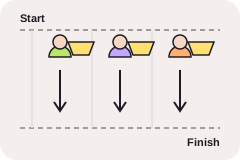
You need A speaking order posted in the chat Suggested setup: relay lanes. Post the speaking order in the chat so nobody talks over each other. Post the speaking order in the chat so nobody talks over each other. The first player says a word. The next says a word linked to it within three seconds. A player who pauses too long or repeats a word starts a new chain. At the end of a chain, try to trace it back to the first word together. Wolves and villagers over private messages
Players 7 to 16
Minutes 20 to 40
Ages 12 and up
You need A host who does not play, and the call's private messages Suggested setup: spread out. The host secretly messages each player a role: two players are wolves, one is the detective, and the rest are villagers. The host secretly messages each player a role: two players are wolves, one is the detective, and the rest are villagers. Night: everyone turns their camera off. The wolves message the host one player to remove, and the detective messages one name to check; the host replies wolf or villager. Day: cameras on. The host says who was removed, and the group discusses and votes one player out. The removed player's role is revealed, and night falls again. Villagers win by removing both wolves. The wolves win if they equal the villagers. Drawing and acting on camera Draw and guess on camera
Players 4 to 20
Minutes 20 to 30
Ages 8 and up
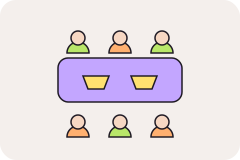
You need Paper and a thick marker for each player, or the call app's whiteboard Suggested setup: tables. The host sends the artist a word by private message. The host sends the artist a word by private message. The artist draws it on paper held up to the camera, or on the shared whiteboard. Everyone else types guesses in the chat. The first right guess scores for the guesser and the artist. The artist picks who draws next, until everyone has had a turn. For this game: Drawing game word generator
Camera charades
Players 4 to 20
Minutes 15 to 30
Ages 6 and up
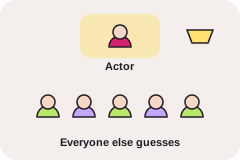
You need A camera for each actor, and prompts sent by private message Suggested setup: one player at the front. The host sends each actor a prompt by private message. The host sends each actor a prompt by private message. Everyone else switches to the view that shows the actor large on screen. The actor acts without sound. Players call out or type their guesses. Pick prompts with big movements, since small gestures are hard to see on a call. A player who would rather stay off camera can describe the prompt without saying its words instead. Draw your neighbor
Players 4 to 16
Minutes 10
Ages 8 and up
You need Paper and a pen for each player Suggested setup: tables. The host privately messages each player the name of someone else to draw. Keep the assignments secret. The host privately messages each player the name of someone else to draw. Keep the assignments secret. Everyone has two minutes to draw that person's face from the screen, then privately sends a photo of the drawing to the host. The host shows the drawings one at a time without naming the artists. Each player guesses which drawing is of them and who drew it. The host reveals the assignments, then the group votes for the best likeness. Games that use the room around you Fetch it fast
Players 4 to 30
Minutes 10 to 15
Ages All ages
You need A list of things most homes have Suggested setup: spread out. The host calls an item, such as something blue, a spoon or the oldest book on your shelf. The host calls an item, such as something blue, a spoon or the oldest book on your shelf. Players leave the camera, find it and hold it up. The first player back with it scores a point. After ten items, the most points wins. Keep items easy to reach, with no climbing. Close-up guess
Players 4 to 30
Minutes 10 to 15
Ages 8 and up
You need 10 to 15 close-up photos of household objects, and a shared screen Suggested setup: spread out. Before the call, photograph ordinary objects from very close, such as a zipper, a sponge or the tip of a pencil. Before the call, photograph ordinary objects from very close, such as a zipper, a sponge or the tip of a pencil. Share one photo at a time. Players type their guess in the chat. Show a photo of the whole object, and give a point for each correct guess. Three clues from home
Players 4 to 20
Minutes 15
Ages 6 and up
You need One object from each player's home, kept out of sight of the camera Suggested setup: spread out. Each player picks an object from their room and keeps it below the camera. Each player picks an object from their room and keeps it below the camera. In turn, each gives three clues without naming it: its size, what it is made of, and what it is for. Others guess in the chat after each clue. The player shows the object. A right guess after the first clue scores three points, after the second two, and after the third one. For a class or work call Call bingo
Players 5 to 50
Minutes Runs through the call
Ages 10 and up
You need A different call bingo card for each player Suggested setup: tables. Send each player a different card before the call, as a PDF or an image. Send each player a different card before the call, as a PDF or an image. Players mark a word when someone says it or it happens on the call, such as mute, chat or connection. The first full line calls bingo in the chat. The host asks the group to confirm the words before naming a winner. Without a printer: Players open the card on a phone and keep track on any paper, or copy nine words into a grid.
For this game: Video call bingo
Whose desk is this
Players 6 to 40
Minutes 15
Ages Adults
You need A photo of each player's desk or work corner, sent to the host before the call Suggested setup: spread out. Ask colleagues who want to join to send a photo of their desk, with nothing private in view. Ask colleagues who want to join to send a photo of their desk, with nothing private in view. Number the photos and share them one at a time. Players type in the chat whose desk they think it is. Reveal each owner, who can say one thing about an object in the photo. Riddle round for a class
Players 5 to 30
Minutes 10
Ages 6 to 11
You need A list of riddles for kids Suggested setup: spread out. Share the riddle on screen and read it aloud twice. Share the riddle on screen and read it aloud twice. Children think quietly for ten seconds, then use the raise-hand button. Call on a child to answer and explain. Show the answer before the next riddle, so the whole class hears why. For this game: Riddles for kids with answers
Freeze dance on camera
Players 4 to 30
Minutes 5 to 10
Ages 3 to 9
You need Music shared through the call Suggested setup: spread out. Share music through the call, with sound sharing turned on. Share music through the call, with sound sharing turned on. Children dance in front of their cameras. Pause the music. Everyone freezes like a statue. Name the funniest freeze, then start the music again. Nobody is out. Timer and team scores Seconds per turn Turns in the session
8 turns × 60 seconds = 8 minutes of play, plus instructions and breaks.
60
Start Pause Reset
Pause whenever the group needs more time.
Teams2 3 4 5 6 Team Lime's turn
Next team Team Lime: 0
Team Lime +1 Team Lime −1 Team Violet: 0
Team Violet +1 Team Violet −1 Team Tangerine: 0
Team Tangerine +1 Team Tangerine −1 Team Sky: 0
Team Sky +1 Team Sky −1 Team Lemon: 0
Team Lemon +1 Team Lemon −1 Team Bubblegum: 0
Team Bubblegum +1 Team Bubblegum −1
More to choose from