
90 logic puzzles with worked solutions
Read the clues, give the group time to reason, then open the worked solution to check the route as well as the answer.
More sets to choose from
-
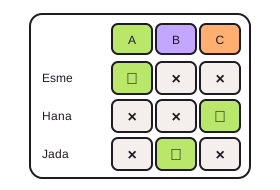 Logic puzzles for kids with answers 24 puzzles
Four friends, four things, one each. Cross off what the clues rule out until only one match is left in every row, then check the worked answer.
-
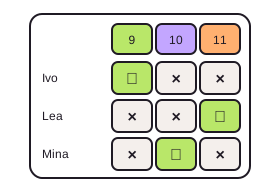 Logic grid puzzles with solutions 18 puzzles
Match each person to one item. Each match can be used only once; the solutions explain each deduction.
-
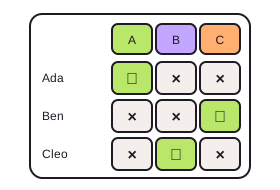 Logic puzzles online with working grids
Mark each pairing as unknown, impossible or confirmed. Check your solution when every row has a confirmed match.
-
 Daily logic puzzle with a worked solution
A new puzzle for each date: a logic grid, a truth-teller puzzle or a number puzzle in turn. Reveal the reasoning or print it with the answer.
-
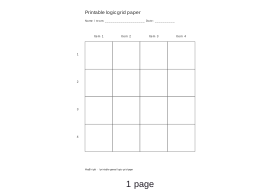 Printable logic grid paper
Print the finished sheet or download its PDF. Use the rules below to set up the game.
-
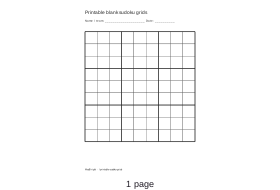 Printable blank sudoku grids
Choose a grid size, then print or download the blank worksheet. Copy your own puzzle into the grid.
90 puzzles · Logic puzzles with worked solutions · answers included
Updated
No puzzles match these filters.
Grid deduction
- 1
Ivo, Lea, and Mina present at 9, 10, and 11, one person per time. Ivo presents at 9. Lea is not at 9. Mina is not at 10. Who presents at 10?
Hint: Ivo takes 9. Of the two people left, who cannot be at 10?
AnswerLea presents at 10.
Ivo uses 9. Mina cannot use 9 or 10, so Mina uses 11. The remaining time, 10, belongs to Lea.
Source: Method source https://mathigon.org/world/Logic_and_Paradoxes
- 2
Ari, Bo, Cia, and Dev each choose one project: kite, maze, robot, or volcano. Ari chooses neither maze, robot, nor volcano. Bo chooses neither robot nor volcano. Cia does not choose volcano. Which project does Dev choose?
Hint: Ari has only one project left. Then look at Bo.
AnswerDev chooses the volcano project.
Ari must have kite. Bo then must have maze. Cia must have robot, leaving volcano for Dev.
Source: Method source https://mathigon.org/world/Logic_and_Paradoxes
- 3
Four workshops use Cedar, Elm, Maple, and Oak rooms. Design is not in Elm, Maple, or Oak. Coding is not in Cedar, Maple, or Oak. Writing is not in Cedar, Elm, or Oak. Where is the Music workshop?
Hint: Design can only be in Cedar. Place Coding and Writing next.
AnswerMusic is in Oak.
Design is forced into Cedar, Coding into Elm, and Writing into Maple. Oak is the only room left for Music.
Source: Method source https://mathigon.org/world/Logic_and_Paradoxes
- 4
Four labeled lunch boxes contain apple, crackers, grapes, and yogurt, one snack each. Box Red has crackers. Box Blue has neither apple nor yogurt. Box Green has neither crackers nor yogurt. What is in Box Yellow?
Hint: Red has the crackers. Which snack is left for Blue?
AnswerBox Yellow contains yogurt.
Red has crackers. Blue cannot have apple or yogurt, so Blue has grapes. Green then has apple. Yogurt remains for Yellow.
Source: Method source https://mathigon.org/world/Logic_and_Paradoxes
- 5
Jae, Kira, Luis, and Noor each visit on Monday, Tuesday, Wednesday, or Thursday. Noor visits Thursday. Jae does not visit Tuesday or Wednesday. Kira does not visit Monday or Wednesday. Which day does Luis visit?
Hint: Noor takes Thursday, so Jae has only Monday left.
AnswerLuis visits Wednesday.
Noor has Thursday. Jae must have Monday. Kira must then have Tuesday. Wednesday remains for Luis.
Source: Method source https://mathigon.org/world/Logic_and_Paradoxes
- 6
Eli, Fara, Gus, Hana, and Ivan wear circle, diamond, moon, square, and star badges. Eli does not wear diamond, moon, square, or star. Fara does not wear moon, square, or star. Gus does not wear square or star. Hana does not wear star. Which badge does Ivan wear?
Hint: Eli has only one badge left. Work down the list from there.
AnswerIvan wears the star badge.
The exclusions force Eli to circle, Fara to diamond, Gus to moon, and Hana to square. Star remains for Ivan.
Source: Method source https://mathigon.org/world/Logic_and_Paradoxes
- 7
Paz, Quin, Ravi, and Sol use lockers 12, 18, 24, and 30. Ravi uses 24. Paz does not use 18 or 30. Quin does not use 12 or 30. Which locker does Sol use?
Hint: Ravi takes 24, so Paz can only use 12.
AnswerSol uses locker 30.
Ravi has 24. Paz must have 12. Quin must have 18. Sol therefore has 30.
Source: Method source https://mathigon.org/world/Logic_and_Paradoxes
- 8
Uma, Vero, Wes, and Xia play drum, flute, piano, and violin. Xia plays violin. Uma plays neither flute nor piano. Vero plays neither drum nor piano. Which instrument does Wes play?
Hint: Xia has the violin, so Uma must play the drum.
AnswerWes plays piano.
Xia has violin. Uma must have drum, and Vero must have flute. Piano remains for Wes.
Source: Method source https://mathigon.org/world/Logic_and_Paradoxes
- 9
Packets A, B, C, and D contain basil, dill, mint, and thyme. Packet B contains dill. Packet A contains neither dill nor mint nor thyme. Packet C contains neither basil, dill, nor thyme. What is in Packet D?
Hint: B has the dill and A can only have basil. What is left for C?
AnswerPacket D contains thyme.
A must contain basil and B contains dill. C cannot contain basil, dill, or thyme, so C has mint. The remaining herb, thyme, belongs in D.
Source: Method source https://mathigon.org/world/Logic_and_Paradoxes
- 10
Four parcels arrive by bike, car, train, and van. Parcel North arrives by train. Parcel East arrives by neither car nor van. Parcel South arrives by neither bike nor van. How does Parcel West arrive?
Hint: North has the train, so East must come by bike.
AnswerParcel West arrives by van.
North uses train. East must use bike. South must use car. Van remains for West.
Source: Method source https://mathigon.org/world/Logic_and_Paradoxes
- 11
Clay, glass, paper, and wood models sit on shelves 1, 2, 3, and 4. Glass is on shelf 2. Clay is not on shelves 2, 3, or 4. Paper is not on shelves 1, 2, or 4. Which shelf holds wood?
Hint: Clay can only be on shelf 1, and paper only on shelf 3.
AnswerWood is on shelf 4.
Clay is forced to shelf 1, glass is on shelf 2, and paper is forced to shelf 3. Wood must be on shelf 4.
Source: Method source https://mathigon.org/world/Logic_and_Paradoxes
- 12
Nia, Oren, and Pia each use a telescope at dawn, noon, or dusk. Oren uses it at noon. Nia uses it at neither noon nor dusk. When does Pia use it?
Hint: Oren has noon, and Nia cannot have dusk.
AnswerPia uses the telescope at dusk.
Oren takes noon. Nia can take neither noon nor dusk, so Nia takes dawn. The remaining slot, dusk, belongs to Pia.
Source: Method source https://mathigon.org/world/Logic_and_Paradoxes
- 13
Red, Blue, Green, and White recipe cards show soup, rice, salad, and stew. White shows stew. Red shows neither rice, salad, nor stew. Blue shows neither soup, salad, nor stew. What does Green show?
Hint: Red can only show soup, and Blue only rice.
AnswerGreen shows salad.
White has stew. Red is excluded from the other three choices, so Red has soup. Blue must then have rice, leaving salad for Green.
Source: Method source https://mathigon.org/world/Logic_and_Paradoxes
- 14
Kite, Lime, Moss, and Navy envelopes contain a badge, map, pass, and token. Moss contains the pass. Kite contains neither the map, pass, nor token. Lime contains neither the badge, pass, nor token. What is in Navy?
Hint: Kite can only hold the badge, and Lime only the map.
AnswerNavy contains the token.
Moss has the pass. Kite is forced to the badge and Lime is forced to the map. The only insert left for Navy is the token.
Source: Method source https://mathigon.org/world/Logic_and_Paradoxes
- 15
Aster, Birch, Cedar, Dune, and Elm segments occupy radio slots 1 through 5. Aster has slot 3. Birch has none of slots 2 through 5. Cedar has neither slot 1 nor slots 3 through 5. Dune has neither slots 1 through 3 nor slot 5. Which slot has Elm?
Hint: Birch can only have slot 1, Cedar only slot 2 and Dune only slot 4.
AnswerElm has slot 5.
Aster has 3. The exclusions force Birch to 1, Cedar to 2, and Dune to 4. Slot 5 remains for Elm.
Source: Method source https://mathigon.org/world/Logic_and_Paradoxes
- 16
Five lanterns named Arc, Beam, Cove, Drift, and Echo glow amber, blue, green, silver, and violet. Cove glows green. Arc glows neither blue, green, silver, nor violet. Beam glows neither amber, green, silver, nor violet. Drift glows neither amber, blue, green, nor violet. What color is Echo?
Hint: Arc can only be amber, Beam only blue and Drift only silver.
AnswerEcho glows violet.
Cove has green. Arc is forced to amber, Beam to blue, and Drift to silver. Violet is the remaining color for Echo.
Source: Method source https://mathigon.org/world/Logic_and_Paradoxes
- 17
Poster tubes J, K, L, M, and N hold art, code, dance, music, and science posters. Tube L holds dance. Tube J holds neither code, dance, music, nor science. Tube K holds neither art, dance, music, nor science. Tube M holds neither art, code, dance, nor science. Which poster is in Tube N?
Hint: J can only hold art, K only code and M only music.
AnswerTube N holds the science poster.
Tube L has dance. The exclusions force J to art, K to code, and M to music. Science remains for Tube N.
Source: Method source https://mathigon.org/world/Logic_and_Paradoxes
- 18
Folders A through F have coral, gold, gray, lilac, teal, and white tabs. Folder C has gray. A has none of gold, gray, lilac, teal, or white. B has none of coral, gray, lilac, teal, or white. D has none of coral, gold, gray, teal, or white. E has none of coral, gold, gray, lilac, or white. Which tab does F have?
Hint: A, B, D and E each have only one tab left.
AnswerFolder F has the white tab.
C has gray. The exclusions force A to coral, B to gold, D to lilac, and E to teal. White remains for F.
Source: Method source https://mathigon.org/world/Logic_and_Paradoxes
Sequence rules
- 19
Start at 4 and add 7 each time: 4, 11, 18, 25, 32. What is the next term?
Hint: Add 7 to the last term.
Answer39.
Add 7 to 32. The result is 39.
Source: Method source https://nrich.maths.org/patterns-and-sequences-short-problems-0
- 20
Start at 2 and multiply by 3 each time: 2, 6, 18, 54. What is the next term?
Hint: Multiply the last term by 3.
Answer162.
Multiply 54 by 3. The result is 162.
Source: Method source https://nrich.maths.org/patterns-and-sequences-short-problems-0
- 21
Starting at 4, alternate add 3 and multiply by 2: 4, 7, 14, 17, 34. What is next?
Hint: The last step was multiplying by 2, so now add 3.
Answer37.
The last operation shown was multiply by 2, so the next operation is add 3. Then 34 + 3 = 37.
Source: Method source https://nrich.maths.org/patterns-and-sequences-short-problems-0
- 22
Start at 3 and add consecutive even numbers 2, 4, 6, 8, and so on: 3, 5, 9, 15, 23, 33. What is next?
Hint: The last addition was 10. Add the next even number.
Answer45.
The next even-number gap is 12, so 33 + 12 = 45.
Source: Method source https://nrich.maths.org/patterns-and-sequences-short-problems-0
- 23
The nth term is n times n + 1, beginning with n = 1: 2, 6, 12, 20, 30. What is the sixth term?
Hint: Put n = 6 into n times n + 1.
Answer42.
For n = 6, calculate 6 times 7, which is 42.
Source: Method source https://nrich.maths.org/patterns-and-sequences-short-problems-0
- 24
Begin with 2 and 3, then make each new term the sum of the previous two: 2, 3, 5, 8, 13, 21. What is next?
Hint: Add the last two terms.
Answer34.
Add the previous two terms: 13 + 21 = 34.
Source: Method source https://nrich.maths.org/patterns-and-sequences-short-problems-0
- 25
The odd-position terms start at 2 and rise by 4. The even-position terms start at 20 and fall by 3: 2, 20, 6, 17, 10, 14, 14, 11. What is next?
Hint: The ninth term is in an odd position: 2, 6, 10, 14, and then?
Answer18.
The next term is in an odd position. Continue 2, 6, 10, 14 by adding 4 to get 18.
Source: Method source https://nrich.maths.org/patterns-and-sequences-short-problems-0
- 26
Start at 3. Double each term and subtract 1: 3, 5, 9, 17, 33. What is next?
Hint: Double 33, then take away 1.
Answer65.
Double 33 to get 66, then subtract 1 to get 65.
Source: Method source https://nrich.maths.org/patterns-and-sequences-short-problems-0
- 27
Starting at 10, add 5, subtract 2, add 10, subtract 4, add 15, and continue the two growing patterns: 10, 15, 13, 23, 19, 34. What is next?
Hint: The subtractions grow by 2 each time: 2, 4, then 6.
Answer28.
The subtraction amounts are 2, 4, then 6. Subtract 6 from 34 to get 28.
Source: Method source https://nrich.maths.org/patterns-and-sequences-short-problems-0
- 28
The nth term is n cubed minus 1, beginning with n = 1: 0, 7, 26, 63, 124. What is the sixth term?
Hint: 6 cubed is 6 times 6 times 6.
Answer215.
Six cubed is 216. Subtract 1 to get 215.
Source: Method source https://nrich.maths.org/patterns-and-sequences-short-problems-0
Balance-scale deductions
- 29
Coins A, B, and C contain exactly one heavier coin. A balances B. Which coin is heavier?
Hint: If A and B balance, neither of them is the heavy coin.
AnswerCoin C.
A and B have equal weight, so neither can be the one heavier coin. C is the only candidate left.
Source: Method source https://nrich.maths.org/problems/weighing-scales
- 30
Among A, B, C, and D, exactly one item is lighter. A and B outweigh C and D. Then C outweighs D. Which item is lighter?
Hint: The light item sits on the lighter side of the first weighing.
AnswerD is lighter.
The first weighing places the lighter item among C and D. Since C outweighs D, D is the lighter item.
Source: Method source https://nrich.maths.org/problems/weighing-scales
- 31
Five items A through E include exactly one heavier item. A and B balance C and D. Which item is heavier?
Hint: Four items that balance are all normal.
AnswerE is heavier.
All four weighed items balance in equal-size groups, so none is heavier. The unweighed item E must be heavier.
Source: Method source https://nrich.maths.org/problems/weighing-scales
- 32
Six items A through F include exactly one lighter item. A, B, and C are lighter as a group than D, E, and F. Then A outweighs B. Which item is lighter?
Hint: The light item is among A, B and C. What does the second weighing say about two of them?
AnswerB is lighter.
The first result puts the lighter item among A, B, and C. A outweighs B, so B is lighter than A. If C were lighter, A and B would balance. Therefore B is the odd item.
Source: Method source https://nrich.maths.org/problems/weighing-scales
- 33
Seven items A through G include exactly one heavier item. A, B, and C balance D, E, and F. Which item is heavier?
Hint: Six items that balance are all normal.
AnswerG is heavier.
The six weighed items balance, so the only unweighed candidate G is heavier.
Source: Method source https://nrich.maths.org/problems/weighing-scales
- 34
Eight labeled items A through H include exactly one heavier item. A, B, and C are lighter as a group than D, E, and F. D balances E. Which item is heavier?
Hint: The heavy item is on the heavier side: D, E or F.
AnswerF is heavier.
The first result puts the heavier item among D, E, and F. D balances E, so F is the only candidate.
Source: Method source https://nrich.maths.org/problems/weighing-scales
- 35
One item among A through H is lighter than all the others. A, B, and C are lighter as a group than D, E, and F. A balances B. Which item is lighter?
Hint: The light item is among A, B and C.
AnswerC is lighter.
The first result puts the lighter item among A, B, and C. A balances B, leaving C.
Source: Method source https://nrich.maths.org/problems/weighing-scales
- 36
Of the nine items A through I, exactly one is heavier. A, B, and C balance D, E, and F. Then G is lighter than H. Which item is heavier?
Hint: A to F balanced, so they are all normal.
AnswerH is heavier.
The first balance puts the heavier item among G, H, and I. H outweighs G. If I were heavier, G and H would balance. Therefore H is heavier.
Source: Method source https://nrich.maths.org/problems/weighing-scales
- 37
Within items A through J, exactly one is lighter. A, B, and C balance D, E, and F. G and H outweigh I and J. Then I outweighs J. Which item is lighter?
Hint: The light item is on the lighter side of the second weighing: I or J.
AnswerJ is lighter.
The first balance leaves G, H, I, and J. The second result places the lighter item among I and J. Since I outweighs J, J is lighter.
Source: Method source https://nrich.maths.org/problems/weighing-scales
- 38
Twelve items labeled A through L include exactly one heavier item. A through D balance E through H. I and J are lighter as a pair than K and L. K outweighs L. Which item is heavier?
Hint: A to H balanced, so the heavy item is in the heavier pair.
AnswerK is heavier.
The first balance leaves I, J, K, and L. The second result puts the heavier item among K and L. The final weighing identifies K.
Source: Method source https://nrich.maths.org/problems/weighing-scales
- 39
Exactly one of four tiles A, B, C, and D is heavier. A balances B, then C outweighs A. Which tile is heavier?
Hint: A and B balance, so both are normal tiles.
AnswerC is heavier.
The balance removes A and B from consideration. C outweighs a known normal tile, so C is the unique heavier tile and D is normal.
Source: Method source https://nrich.maths.org/problems/weighing-scales
- 40
Five counters A through E contain exactly one lighter counter. A and B balance C and D. Which counter is lighter?
Hint: Four counters that balance are all normal.
AnswerE is lighter.
A balanced comparison shows A, B, C, and D all have normal weight. E is the only counter not cleared, so E must be lighter.
Source: Method source https://nrich.maths.org/problems/weighing-scales
- 41
Among six blocks A through F, one is heavier. A and B balance C and D. A second weighing shows E outweighs A. Which block is heavier?
Hint: A to D balanced, so A is a normal block to compare against.
AnswerE is heavier.
The first balance clears A through D, leaving E or F. Since E outweighs the known normal block A, E is the heavier block.
Source: Method source https://nrich.maths.org/problems/weighing-scales
- 42
Seven discs A through G include one lighter disc. A, B, and C balance D, E, and F. Identify the lighter disc.
Hint: Six discs that balance are all normal.
AnswerG is lighter.
The six weighed discs balance, so none of them is the lighter one. G is the only unweighed disc and must be lighter.
Source: Method source https://nrich.maths.org/problems/weighing-scales
- 43
A set of nine tokens A through I has one lighter token. A through D balance E through H. Which token is lighter?
Hint: Eight tokens that balance are all normal.
AnswerI is lighter.
The eight tokens on the balanced pans all have normal weight. I is the only token outside that cleared set, so I is lighter.
Source: Method source https://nrich.maths.org/problems/weighing-scales
- 44
Ten beads A through J include one heavier bead. A through D balance E through H. Then J outweighs I. Which bead is heavier?
Hint: A to H balanced, so the heavy bead is I or J.
AnswerJ is heavier.
The first balance clears A through H and leaves only I or J. J outweighs I, so J is the heavier bead.
Source: Method source https://nrich.maths.org/problems/weighing-scales
- 45
Eleven cubes A through K include one heavier cube. A through D balance E through H, and I balances J. Which cube is heavier?
Hint: A balanced weighing tells you something about every cube on it.
AnswerK is heavier.
The first balance clears A through H. The second balance clears I and J. K is the only cube not shown to be normal, so K is heavier.
Source: Method source https://nrich.maths.org/problems/weighing-scales
River crossings
- 46
One adult weighs 2 units and two children weigh 1 unit each. A boat holds 2 units, everyone can row, and nobody may swim. What is the minimum number of one-way crossings?
Hint: The two children cross first, and one of them brings the boat back.
Answer5 crossings.
Children 1 and 2 cross; Child 1 returns; Adult crosses; Child 2 returns; both children cross. That is five crossings.
Source: Method source https://nrich.maths.org/problems/river-crossing
- 47
Two adults weigh 2 units each and two children weigh 1 unit each. A boat holds 2 units, everyone can row, and nobody may swim. What is the minimum number of one-way crossings?
Hint: Each adult needs the children to bring the boat back: both children over, one back, an adult over, the other child back.
Answer9 crossings.
Both children cross; one returns; Adult 1 crosses; the other child returns; both children cross; one returns; Adult 2 crosses; the other child returns; both children cross. Nine crossings are necessary.
Source: Method source https://nrich.maths.org/problems/river-crossing
- 48
Three adults weigh 2 units each and two children weigh 1 unit each. A boat holds 2 units, everyone can row, and nobody may swim. What is the minimum number of one-way crossings?
Hint: Each adult costs four crossings, and the last trip takes both children.
Answer13 crossings.
Use four crossings to transfer one adult while resetting both children to the starting bank. Repeat for each adult, then send both children across. The total is 4 + 4 + 4 + 1 = 13.
Source: Method source https://nrich.maths.org/problems/river-crossing
- 49
Ari, Bo, and Cy weigh 1, 2, and 3 units. The boat holds 3 units and all three can row. What is the minimum number of one-way crossings?
Hint: Cy fills the boat alone, so Ari and Bo share the other trips.
Answer5 crossings.
Ari and Bo cross; Ari returns; Cy crosses; Bo returns; Ari and Bo cross. The total is five.
Source: Method source https://nrich.maths.org/problems/river-crossing
- 50
Dax, Emi, Flo, and Gio weigh 1, 2, 3, and 4 units. The boat holds 5 units and all four can row. What is the minimum number of one-way crossings?
Hint: Pair people whose weights add up to 5.
Answer5 crossings.
Dax and Gio cross; Dax returns; Emi and Flo cross; Emi returns; Dax and Emi cross. The total is five.
Source: Method source https://nrich.maths.org/problems/river-crossing
- 51
A guide must take a fox, a hen, and grain across. The boat carries the guide plus one item. Without the guide, the fox cannot stay with the hen, and the hen cannot stay with the grain. What is the minimum number of one-way crossings?
Hint: The hen goes first, and it has to come back once.
Answer7 crossings.
Take hen over; return alone; take fox over; bring hen back; take grain over; return alone; take hen over. Seven is the shortest safe route.
Source: Method source https://nrich.maths.org/problems/river-crossing
- 52
A guide must move A, B, C, and D across in a boat holding two items. When unattended, A cannot stay with B, B cannot stay with C, and C cannot stay with D. What is the minimum number of one-way crossings?
Hint: Which two items can safely be left together on either bank?
Answer3 crossings.
Take A and C over; return alone; take B and D over. Both unattended pairs of items are safe, and all four arrive in three crossings.
Source: Method source https://nrich.maths.org/problems/river-crossing
- 53
A guide must move cats C1 and C2 plus mice M1 and M2. The boat holds two animals. When unattended, C1 cannot stay with M1 and C2 cannot stay with M2. What is the minimum number of one-way crossings?
Hint: Move the two cats together first.
Answer3 crossings.
Take both cats over; return alone; take both mice over. Each unattended bank contains only one animal type, so the route is safe and uses three crossings.
Source: Method source https://nrich.maths.org/problems/river-crossing
- 54
A guide must move A, B, C, D, and E in a boat holding two items. When unattended, each neighboring letter pair is unsafe: A-B, B-C, C-D, and D-E. What is the minimum number of one-way crossings?
Hint: A, C and E are safe together. B and D are the ones to watch.
Answer7 crossings.
A shortest safe route is B and D over; return alone; A over; B back; C and E over; D back; B and D over. This uses seven crossings.
Source: Method source https://nrich.maths.org/problems/river-crossing
- 55
Ada and Bran each weigh 1 unit, and Ciro weighs 2 units. A boat holds 3 units, everyone can row, and nobody may swim. What is the minimum number of one-way crossings?
Hint: Ciro can share the boat with one of the lighter rowers.
Answer3 crossings.
Ada and Ciro cross, Ada returns, then Ada and Bran cross. All three finish across in three trips, and one trip cannot carry all 4 units.
Source: Method source https://nrich.maths.org/problems/river-crossing
- 56
Dara and Eli weigh 1 unit each, while Finn and Gail weigh 2 units each. The boat holds 3 units and everyone can row. Find the minimum number of one-way crossings.
Hint: Each heavier person crosses with a lighter one, and a lighter one brings the boat back.
Answer5 crossings.
Dara takes Finn over and returns. Dara takes Gail over and returns again. Dara and Eli then cross together, for five crossings.
Source: Method source https://nrich.maths.org/problems/river-crossing
- 57
Hugo, Iris, and Juno weigh 1 unit each; Kai and Luz weigh 2 units each. The boat holds 3 units and all five can row. Determine the fewest one-way crossings.
Hint: Send a 2-unit and a 1-unit rower together, and let a light rower bring the boat back.
Answer5 crossings.
Hugo takes Kai over and returns, then takes Luz over and returns. Hugo, Iris, and Juno cross together on the fifth trip.
Source: Method source https://nrich.maths.org/problems/river-crossing
- 58
Mara weighs 1 unit and can row. Niko and Ola each weigh 2 units and cannot row. A boat holds 3 units. How few one-way crossings move everyone across?
Hint: Mara is the only rower, so she is on every trip.
Answer3 crossings.
Mara rows Niko across, returns alone, and rows Ola across. Both loaded trips meet the 3-unit limit, so three crossings suffice.
Source: Method source https://nrich.maths.org/problems/river-crossing
- 59
Pax and Quin weigh 1 unit and can row. Rumi and Sela weigh 2 units and cannot row. With a 3-unit boat, what is the minimum number of one-way crossings?
Hint: Each non-rower needs a rower beside them, and a rower brings the boat back.
Answer5 crossings.
Pax rows Rumi across and returns, then rows Sela across and returns. Pax and Quin cross together on trip five.
Source: Method source https://nrich.maths.org/problems/river-crossing
- 60
Tara and Ugo weigh 1 unit and can row. Vera, Wynn, and Xeno weigh 2 units and cannot row. The boat holds 3 units. What is the minimum crossing count?
Hint: Each non-rower crosses with a rower, and a rower brings the boat back after every trip but the last.
Answer7 crossings.
Tara ferries Vera, Wynn, and Xeno one at a time, returning after the first two. Tara returns once more for Ugo, and the two rowers make the seventh crossing together.
Source: Method source https://nrich.maths.org/problems/river-crossing
- 61
Yara and Zed weigh 1 unit each, Ami weighs 2 units, and Bex weighs 3 units. A boat holds 4 units and everyone can row. What is the fewest number of one-way crossings?
Hint: Bex fits in the boat with one of the 1-unit rowers.
Answer3 crossings.
Yara and Bex cross at the 4-unit limit. Yara returns, then crosses with Zed and Ami, again totaling 4 units. Three crossings are enough.
Source: Method source https://nrich.maths.org/problems/river-crossing
- 62
Cora and Deni weigh 1 unit each, Evan weighs 2, and Faye and Gino weigh 3 each. Everyone can row a boat holding 4 units. Find the minimum one-way crossings.
Hint: Each 3-unit person crosses with a 1-unit rower.
Answer5 crossings.
Cora takes Faye across and returns, then takes Gino across and returns. Cora, Deni, and Evan make the fifth trip at the 4-unit limit.
Source: Method source https://nrich.maths.org/problems/river-crossing
Knights and knaves
- 63
On the island, A says, 'B and I are different types.' B says, 'A is a knave.' Who is who?
Hint: Suppose A is a knight. Then B is a knave. Does B's statement fit?
AnswerA=knight; B=knave.
If A is truthful, the two differ, so B is a knave and B's claim is false. If A is a knave, the two would be the same, making B a knave whose claim that A is a knave is true, which is impossible.
Source: Method source https://mathigon.org/world/Logic_and_Paradoxes
- 64
A says, 'B is a knight.' B says, 'A and I are different types.' Who is who?
Hint: Suppose B is a knight and check whether A's statement can then be true.
AnswerA=knave; B=knave.
If A were a knight, B would be a knight, but then B's different-types claim would be false. Therefore A is a knave, so B is not a knight. Both are knaves, making B's different-types claim false as required.
Source: Method source https://mathigon.org/world/Logic_and_Paradoxes
- 65
A says, 'B and I are both knaves.' A is the only speaker. Who is who?
Hint: A knight could never say that he is a knave.
AnswerA=knave; B=knight.
A cannot be a knight while truthfully calling A a knave. So A is a knave and the whole statement is false. With A already a knave, B must be a knight to make 'both knaves' false.
Source: Method source https://mathigon.org/world/Logic_and_Paradoxes
- 66
A says, 'A and B are both knaves.' B says, 'C is a knave.' Who is who?
Hint: A cannot be a knight, because a knight would not call himself a knave.
AnswerA=knave; B=knight; C=knave.
A's self-including claim forces A to be a knave and B to be a knight. B then speaks truthfully, so C is a knave.
Source: Method source https://mathigon.org/world/Logic_and_Paradoxes
- 67
A says, 'A and B are both knaves.' B says, 'C is a knave.' C says, 'D is a knight.' Who is who?
Hint: Start with A, who cannot be a knight, then follow the chain.
AnswerA=knave; B=knight; C=knave; D=knave.
The first statement forces A knave and B knight. B truthfully makes C a knave. C's statement must be false, so D is a knave.
Source: Method source https://mathigon.org/world/Logic_and_Paradoxes
- 68
A says, 'Exactly one of A and B is a knight.' B says, 'C is a knight.' C says, 'A is a knave.' Who is who?
Hint: Suppose A is a knight. Then B must be a knave.
AnswerA=knight; B=knave; C=knave.
Testing the eight role rows leaves one consistent row: A knight makes the exactly-one claim true; B knave makes 'C is a knight' false; C knave makes 'A is a knave' false.
Source: Method source https://mathigon.org/world/Logic_and_Paradoxes
- 69
A says, 'B is a knight or C is a knight.' B says, 'A is a knave.' C says, 'B is a knave.' Who is who?
Hint: Try B as a knight and see what that does to A's statement.
AnswerA=knight; B=knave; C=knight.
A knight makes the or-claim true through C. B is a knave because its claim about A is false. C is a knight because it truthfully identifies B.
Source: Method source https://mathigon.org/world/Logic_and_Paradoxes
- 70
A says, 'B and C are the same type.' B says, 'A is a knight.' C says, 'B is a knave.' Who is who?
Hint: C calls B a knave, so B and C are different types.
AnswerA=knave; B=knave; C=knight.
The consistent row has A knave, so A's same-type claim is false. B is a knave and falsely calls A a knight. C is a knight and truthfully calls B a knave.
Source: Method source https://mathigon.org/world/Logic_and_Paradoxes
- 71
A says, 'Exactly one of B and C is a knight.' B says, 'A is a knave.' C says, 'B is a knave.' Who is who?
Hint: C calls B a knave, so B and C are different types. What does that make A's statement?
AnswerA=knight; B=knave; C=knight.
A and C as knights and B as knave makes every statement fit: exactly one of B and C is a knight, B falsely calls A a knave, and C truthfully calls B a knave.
Source: Method source https://mathigon.org/world/Logic_and_Paradoxes
- 72
A says, 'Exactly one of B and C is a knave.' B says, 'A is a knight.' C says, 'B is a knave.' D says, 'C is a knave.' Who is who?
Hint: C calls B a knave, so B and C are different types. What does that make A's statement?
AnswerA=knight; B=knight; C=knave; D=knight.
A, B, and D speak truthfully while C lies. Exactly one of B and C is a knave, B correctly identifies A, C falsely identifies B, and D correctly identifies C.
Source: Method source https://mathigon.org/world/Logic_and_Paradoxes
- 73
A says, 'It is not true that B and C are both knights.' B says, 'A and C are different types.' C says, 'A is a knight.' Who is who?
Hint: C's statement means A and C are the same type. What does that make B's statement?
AnswerA=knight; B=knave; C=knight.
With A and C knights and B knave, A truthfully denies that B and C are both knights, B falsely says A and C differ, and C truthfully identifies A.
Source: Method source https://mathigon.org/world/Logic_and_Paradoxes
- 74
Two islanders speak. A says, 'B is a knave.' B says, 'A and B are different types.' Determine both roles.
Hint: Suppose B is a knight. Then A is a knave. Check A's statement.
AnswerA=knave; B=knight.
If A were a knight, B would be a knave but B's different-types statement would be true. Therefore A is a knave, A's claim is false, and B is a knight.
Source: Method source https://mathigon.org/world/Logic_and_Paradoxes
- 75
A says, 'Exactly one of A, B, and C is a knight.' B says, 'A is a knight.' C says, 'B is a knight.' Assign every role.
Hint: If A were a knight, B would be a knight too. Count the knights.
AnswerA=knave; B=knave; C=knave.
If A were truthful, B and then C would also be knights, contradicting A's count of one. With A a knave, B and C both speak falsely, leaving zero knights and making A's count false.
Source: Method source https://mathigon.org/world/Logic_and_Paradoxes
- 76
Three islanders speak. A says, 'B is a knight.' B says, 'C is a knave.' C says, 'A and B are the same type.' Identify A, B, and C.
Hint: A's statement means A and B are the same type. What does that make C's statement?
AnswerA=knave; B=knave; C=knight.
A's statement makes A and B the same type. C therefore tells the truth, so C is a knight. B's claim that C is a knave is false, making B and A knaves.
Source: Method source https://mathigon.org/world/Logic_and_Paradoxes
- 77
A says, 'B and C are different types.' B says, 'A is a knave.' C says, 'B is a knight.' Find the three roles.
Hint: C's statement means B and C are the same type. What does that make A's statement?
AnswerA=knave; B=knight; C=knight.
C has the same role as B because C claims B is a knight. A's different-types claim is therefore false, so A is a knave. B then truthfully identifies A.
Source: Method source https://mathigon.org/world/Logic_and_Paradoxes
- 78
A says, 'B is a knave.' B says, 'C is a knight.' C says, 'D is a knave.' D says, 'A and C are the same type.' Who is who?
Hint: A's statement means A and B are different types. Try B as a knight.
AnswerA=knave; B=knight; C=knight; D=knave.
The first three statements force A opposite B, B equal to C, and C opposite D. Thus A and D match while A and C differ. D's same-type claim is false, fixing D and A as knaves and B and C as knights.
Source: Method source https://mathigon.org/world/Logic_and_Paradoxes
- 79
A says, 'Exactly two of A, B, C, and D are knights.' B says, 'A is a knight.' C says, 'B is a knave.' D says, 'C is a knight.' Resolve the roles.
Hint: B's statement means A and B are the same type, and D's means C and D are the same type.
AnswerA=knight; B=knight; C=knave; D=knave.
B must match A, while C and D must both oppose A. Either branch contains two knights, so A's count is true and A must be a knight. The chain then fixes B as knight and C and D as knaves.
Source: Method source https://mathigon.org/world/Logic_and_Paradoxes
- 80
A says, 'Exactly four of A, B, C, D, and E are knights.' B says, 'A is a knight.' C says, 'B is a knight.' D says, 'C is a knave.' E says, 'D is a knight.' Assign all five roles.
Hint: A, B and C are all the same type. Could all three be knights with A's count true?
AnswerA=knave; B=knave; C=knave; D=knight; E=knight.
B and C match A, while D and E oppose A. This creates either three or two knights, never four, so A's statement is false. A, B, and C are knaves, while D and E are knights.
Source: Method source https://mathigon.org/world/Logic_and_Paradoxes
Cryptarithms
- 81
Solve SEND + MORE = MONEY. Different letters are different digits, and a leading letter is not zero.
Hint: M is the carry from adding two four-digit numbers, so M is 1.
Answer9567 + 1085 = 10652. S=9, E=5, N=6, D=7, M=1, O=0, R=8, Y=2.
Column-by-column carry constraints and distinct digits leave one mapping: S9 E5 N6 D7 M1 O0 R8 Y2.
Source: Method source https://nrich.maths.org/sites/default/files/thumbnails/content-01-06-six2-Two%252520and%252520Two.pdf
- 82
Solve I + BB = ILL. Different letters are different digits, and a leading letter is not zero.
Hint: ILL has three digits, so I must be 1.
Answer1 + 99 = 100. I=1, B=9, L=0.
The hundreds carry forces I=1. The tens and ones columns then force B=9 and L=0.
Source: Method source https://nrich.maths.org/sites/default/files/thumbnails/content-01-06-six2-Two%252520and%252520Two.pdf
- 83
Solve CROSS + ROADS = DANGER. Different letters are different digits, and a leading letter is not zero.
Hint: D is the carry from adding two five-digit numbers.
Answer96233 + 62513 = 158746. C=9, R=6, O=2, S=3, A=5, D=1, N=8, G=7, E=4.
Exhaustive column search leaves the mapping C9 R6 O2 S3 A5 D1 N8 G7 E4.
Source: Method source https://nrich.maths.org/sites/default/files/thumbnails/content-01-06-six2-Two%252520and%252520Two.pdf
- 84
Solve FORTY + TEN + TEN = SIXTY. Different letters are different digits, and a leading letter is not zero.
Hint: In the last two columns, TY + EN + EN ends in TY, so EN + EN ends in 00.
Answer29786 + 850 + 850 = 31486. F=2, O=9, R=7, T=8, Y=6, E=5, N=0, S=3, I=1, X=4.
Exhaustive column search leaves F2 O9 R7 T8 Y6 E5 N0 S3 I1 X4.
Source: Method source https://nrich.maths.org/sites/default/files/thumbnails/content-01-06-six2-Two%252520and%252520Two.pdf
- 85
Solve DONALD + GERALD = ROBERT. Different letters are different digits, and a leading letter is not zero.
Hint: In the ones column D + D ends in T. Try the D that makes T zero.
Answer526485 + 197485 = 723970. D=5, O=2, N=6, A=4, L=8, G=1, E=9, R=7, B=3, T=0.
Exhaustive column search leaves D5 O2 N6 A4 L8 G1 E9 R7 B3 T0.
Source: Method source https://nrich.maths.org/sites/default/files/thumbnails/content-01-06-six2-Two%252520and%252520Two.pdf
- 86
Solve BASE + BALL = GAMES. Different letters are different digits, and a leading letter is not zero.
Hint: G is the carry from adding two four-digit numbers.
Answer7483 + 7455 = 14938. B=7, A=4, S=8, E=3, L=5, G=1, M=9.
Exhaustive column search leaves B7 A4 S8 E3 L5 G1 M9.
Source: Method source https://nrich.maths.org/sites/default/files/thumbnails/content-01-06-six2-Two%252520and%252520Two.pdf
- 87
Solve EAT + THAT = APPLE. Different letters are different digits, and a leading letter is not zero.
Hint: APPLE has five digits, so A is 1 and THAT must be close to 10,000.
Answer819 + 9219 = 10038. E=8, A=1, T=9, H=2, P=0, L=3.
Exhaustive column search leaves E8 A1 T9 H2 P0 L3.
Source: Method source https://nrich.maths.org/sites/default/files/thumbnails/content-01-06-six2-Two%252520and%252520Two.pdf
- 88
Solve COCA + COLA = OASIS. Different letters are different digits, and a leading letter is not zero.
Hint: O is the carry from adding two four-digit numbers.
Answer8186 + 8106 = 16292. C=8, O=1, A=6, L=0, S=2, I=9.
Exhaustive column search leaves C8 O1 A6 L0 S2 I9.
Source: Method source https://nrich.maths.org/sites/default/files/thumbnails/content-01-06-six2-Two%252520and%252520Two.pdf
- 89
Solve TO + GO = OUT. Different letters are different digits, and a leading letter is not zero.
Hint: OUT has three digits, so O is 1.
Answer21 + 81 = 102. T=2, O=1, G=8, U=0.
Exhaustive column search is used to test whether this proposed mapping is the only valid one.
Source: Method source https://nrich.maths.org/sites/default/files/thumbnails/content-01-06-six2-Two%252520and%252520Two.pdf
- 90
Solve NO + NO + TOO = LATE. Different letters are different digits, and a leading letter is not zero.
Hint: LATE has four digits, so L is 1 and TOO is in the 900s.
Answer74 + 74 + 944 = 1092. N=7, O=4, T=9, L=1, A=0, E=2.
Exhaustive column search is used to test whether this proposed mapping is the only valid one.
Source: Method source https://nrich.maths.org/sites/default/files/thumbnails/content-01-06-six2-Two%252520and%252520Two.pdf
Questions about logic puzzles with worked solutions
How do you solve a logic grid puzzle?
List one group of things across the top of a grid and the other down the side. Put a cross where a clue rules a pairing out and a tick where it confirms one. When a row has one open square left, that is the match.
Can I solve logic puzzles online?
Yes. The online logic grid lets you mark each pairing and checks your grid, and the grid paper page prints blank grids for any puzzle.
Is there a new puzzle every day?
Yes. The daily puzzle page shows a new puzzle for each date, taking turns between a logic grid, a truth-teller puzzle and a number puzzle, and keeps the last 30 days to revisit.
Which puzzles suit children?
The logic puzzles for kids page has short four-person grids, and each answer crosses off the clues step by step.