
115 brain teasers with answers
The main brain teaser collection, easiest first, each with its worked answer. Sets for kids, teens, math and pictures are below.
More sets to choose from
-
 Brain teasers for kids with answers 47 puzzles
Short number, order and word puzzles with explanations. Work on paper or read them aloud.
-
 Brain teasers for teens with answers 32 puzzles
Number, pattern, word and deduction puzzles for ages 11 to 18, each marked easy, medium or hard. Every answer shows the reasoning, so a class or group can check the method as well as the result.
-
 Math brain teasers with answers 40 puzzles
Math puzzles from easy to hard, grouped by topic with the difficulty marked on each. Every answer shows the working, so you can check the method as well as the result.
-
 Word brain teasers with answers 23 puzzles
Solve each question before opening its explanation. Print the set with every answer for a group.
-
 Rebus and picture brain teasers 6 puzzles
Read the positions and repetitions in each text picture as well as the words.
-
 Spot the difference puzzles with answers 8 puzzles
Compare each pair of rows. Find the changed character before revealing the answer.
-
 Brain teasers for adults
115 puzzles · Brain teasers with answers · answers included
Updated
No puzzles match these filters.
Easy brain teasers
- 1
You pass the runner currently in second place. Which place do you now hold?
easy
Hint: You did not pass the leader.
AnswerSecond place.
Passing the second-place runner puts you in that runner's former position.
- 2
One match is available beside a candle, a lantern, and a fireplace. What must be lit first?
easy
Hint: What do you need before you can light anything at all?
AnswerThe match.
The match must be burning before it can light any listed object.
- 3
A bus leaves at 9:35 a.m. and travels for 2 hours 45 minutes. What is its arrival time?
easy
Hint: Add the 2 hours first, then the 45 minutes, and watch for noon.
Answer12:20 p.m.
9:35 plus 2 hours is 11:35, and another 45 minutes is 12:20.
- 4
Rearrange LISTEN into a word associated with quiet.
easy
Hint: Use all six letters. A quiet room is...
AnswerSILENT.
LISTEN and SILENT each contain E, I, L, N, S, and T exactly once.
- 5
Uma finishes before Rae, Rae before Sol, and Sol before Tia. Who finishes first?
easy
Hint: Who is never said to finish after anyone?
AnswerUma.
The clues form the order Uma, Rae, Sol, Tia.
- 6
Choose one of 3 shirts, one of 4 pairs of trousers, and one of 2 hats. How many outfits are possible?
easy
Hint: Multiply the numbers of choices together.
Answer24 outfits.
The multiplication principle gives 3 x 4 x 2 = 24.
- 7
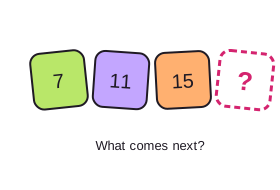
An arithmetic sequence starts 7, 11, 15, 19. Continue it by one term.
easy
Hint: Look at how much each number goes up by.
Answer23. Add 4 each time.
The consecutive differences are 4, 4, and 4, so 19 + 4 = 23.
- 8
Socks come in four colors. Without looking, how many socks guarantee that two share a color?
easy
Hint: Imagine the unluckiest draw: one sock of each color first.
AnswerFive socks.
The first four socks could all differ. A fifth must match one of those four colors.
- 9
The letters of EARTH can name a body organ. Name it.
easy
Hint: It beats in your chest.
AnswerHEART.
EARTH and HEART use the same letters: A, E, H, R, and T.
- 10
Dena is taller than Eli. Farah is shorter than Dena but taller than Eli. Order them from tallest to shortest.
easy
Hint: Farah fits between the other two.
AnswerDena, Farah, Eli.
Dena is above both others, and Farah is explicitly above Eli.
- 11
A recipe uses 240 grams of flour for 6 muffins. At the same rate, how much flour makes 15 muffins?
easy
Hint: Work out the flour for one muffin first.
Answer600 grams.
240 / 6 = 40 grams per muffin, and 40 x 15 = 600 grams.
- 12
Supply the next term of the arithmetic sequence 42, 37, 32, 27.
easy
Hint: Check the gap between neighboring numbers. Is it the same each time?
Answer22. Subtract 5 each time.
Each term is 5 less than the previous term, so 27 - 5 = 22.
- 13
Thirteen people record only their birth month. What must be true?
easy
Hint: There are only twelve months to go around.
AnswerAt least two people recorded the same month.
Twelve labels cannot hold 13 records with at most one record per label.
- 14
Turn COLD into a precious metal by changing one letter.
easy
Hint: Change the first letter.
AnswerGOLD.
Replacing C with G changes COLD to GOLD.
- 15
Four lockers stand left to right. P is at the far left, Q is immediately right of P, and S is at the far right. Where is R?
easy
Hint: Place the three named lockers first. One spot is left.
AnswerThird from the left.
P occupies 1, Q occupies 2, and S occupies 4, leaving position 3 for R.
- 16
On a map, 3 centimeters represents 12 kilometers. What distance does 8 centimeters represent?
easy
Hint: How many kilometers does 1 centimeter stand for?
Answer32 kilometers.
12 / 3 = 4 kilometers per centimeter, and 8 x 4 = 32 kilometers.
- 17
Extend the geometric sequence 3, 9, 27, 81 by one term.
easy
Hint: Each number is the one before it multiplied by the same amount.
Answer243. Multiply by 3 each time.
Each term divided by the previous term is 3, so 81 x 3 = 243.
- 18
Every amber token is round, and no round token is wooden. Could an amber token be wooden?
easy
Hint: An amber token is round. What do we know about round tokens?
AnswerNo.
Amber implies round, and round excludes wooden, so amber excludes wooden.
- 19
A one-letter change turns MOUSE into a building. Which word results?
easy
Hint: Change the first letter to make somewhere people live.
AnswerHOUSE.
Replacing M with H changes MOUSE to HOUSE.
- 20
Art, music, and science talks occur at 1, 2, and 3 o'clock, one per hour. Science is at 3, and art is before music. When is music?
easy
Hint: Science takes 3 o'clock, which leaves 1 and 2.
Answer2 o'clock.
With science at 3, art and music occupy 1 and 2. Art must be earlier, so music is at 2.
- 21
Triple a number and add 4 to get 31. What is the number?
easy
Hint: Take away the 4 first, then undo the tripling.
Answer9.
3x + 4 = 31, so 3x = 27 and x = 9.
- 22
A geometric sequence with positive terms reads 160, 80, 40, 20. Which term is next?
easy
Hint: Compare each number with the one before it. What happens every time?
Answer10. Divide by 2 each time.
Each term is half the previous term, and half of 20 is 10.
- 23
Some poets are cyclists, and all cyclists wear helmets. What follows about the poets who are cyclists?
easy
Hint: Follow the chain from poet-cyclist to cyclist to helmet.
AnswerThose poets wear helmets.
Every member of the cyclist set wears a helmet, including the poets in that set.
- 24
Delete the first letter of PLANE to name a narrow road.
easy
Hint: Think of a narrow country road.
AnswerLANE.
PLANE without its first letter P is LANE.
- 25
A code replaces each letter with the next letter of the alphabet. Decode DBU.
easy
Hint: Move each letter one place back in the alphabet.
AnswerCAT.
Moving D, B, and U back one letter gives C, A, and T.
- 26
A rectangle has perimeter 38 units and length 12 units. Find its width.
easy
Hint: The two lengths use 24 units of the perimeter.
Answer7 units.
2 x (12 + width) = 38, so 12 + width = 19 and the width is 7.
- 27
Starting with 2 and 3, each new term is the sum of the previous two. What follows 2, 3, 5, 8, 13?
easy
Hint: Add the last two numbers together.
Answer21.
The previous two terms are 8 and 13, and 8 + 13 = 21.
- 28
From TRAIN remove one letter to get precipitation.
easy
Hint: It falls from clouds.
AnswerRAIN.
Removing T from TRAIN leaves RAIN.
- 29
Box A contains the key to B, B contains the key to C, and C holds the prize. Which box must be opened first?
easy
Hint: Which box can you open without a key from another box?
AnswerBox A.
Opening B requires A's key, and opening C requires B's key, so A must precede both.
- 30
The base of a triangle is 14 units and its perpendicular height is 9 units. What is its area?
easy
Hint: A triangle is half of a rectangle with the same base and height.
Answer63 square units.
Triangle area is one-half x base x height, so 14 x 9 / 2 = 63.
- 31
Advance three months at a time from February to May to August to November. Name the next month.
easy
Hint: Count three months on from November, past the end of the year.
AnswerFebruary.
Three months after November is February of the next year.
- 32
Insert one letter into PLAN to make a flying vehicle.
easy
Hint: The new letter goes on the end.
AnswerPLANE.
Adding E after PLAN produces PLANE.
- 33
A three-digit password has a first digit twice its second and a third digit one less than its second. The second digit is 3. What is the password?
easy
Hint: The second digit is 3, so the first digit is twice 3.
Answer632.
Twice 3 is 6, and one less than 3 is 2.
- 34
A bag holds 5 red, 3 blue, and 2 green counters. What is the probability of drawing green once?
easy
Hint: How many counters are green, out of how many in all?
Answer1/5.
There are 2 green counters among 10 total, and 2/10 simplifies to 1/5.
- 35
Perfect squares begin 1, 4, 9, 16, 25. Supply the sixth term.
easy
Hint: The fifth term is 5 times 5.
Answer36.
The terms are 1 squared, 2 squared, 3 squared, 4 squared, and 5 squared. The sixth term is 6 squared, which is 36.
- 36
Which letter can be added to STAR to mean the beginning of something?
easy
Hint: A race has one of these, and so does a film.
AnswerAdd T to make START.
Appending T to STAR spells START.
- 37
A meeting is after Monday but before Thursday, and it is not on Wednesday. Which day is it?
easy
Hint: List the days between Monday and Thursday.
AnswerTuesday.
The days after Monday and before Thursday are Tuesday and Wednesday; excluding Wednesday leaves Tuesday.
- 38
Reading the prime numbers in order gives 2, 3, 5, 7, 11. Which number follows?
easy
Hint: Which number after 11 can be divided only by 1 and itself?
Answer13.
The integer after 11 is 12, which has factors other than 1 and itself. The next integer, 13, has only 1 and 13 as positive factors.
- 39
Tooth, hair, and paint share which following word?
easy
Hint: You hold one in your hand for all three jobs.
AnswerBRUSH: toothbrush, hairbrush, and paintbrush.
Appending BRUSH forms TOOTHBRUSH, HAIRBRUSH, and PAINTBRUSH.
- 40
Cubes appear in order as 1, 8, 27, 64. Name the next cube.
easy
Hint: 64 is 4 times 4 times 4. Try 5.
Answer125.
The terms are 1 cubed through 4 cubed. The next is 5 cubed = 5 x 5 x 5 = 125.
- 41
An animal is hidden in eduCATION. Which one?
easy
Hint: Look at the capital letters.
AnswerCAT.
eduCATION contains C, A, T consecutively.
- 42
Decode alphabet positions 8-5-1-20 as a word.
easy
Hint: 8 is H, the eighth letter.
AnswerHEAT.
Alphabet positions 8, 5, 1, and 20 are H, E, A, and T.
- 43
Using A=1 through Z=26, what word is 13-1-16?
easy
Hint: 13 is M, the thirteenth letter.
AnswerMAP.
Alphabet positions 13, 1, and 16 are M, A, and P.
- 44
Rearrange BELOW to name a joint in the arm.
easy
Hint: It bends in the middle of your arm.
AnswerELBOW.
BELOW and ELBOW each contain B, E, L, O, and W exactly once.
- 45
Reverse DRAW to name an area in a hospital.
easy
Hint: Read the word from right to left.
AnswerWARD.
Reading the letters D-R-A-W from right to left gives W-A-R-D.
- 46
Take the first letters of Bright Owls Observe Keenly. What word appears?
easy
Hint: Read only the capital letters.
AnswerBOOK.
The initial letters of Bright, Owls, Observe, and Keenly are B, O, O, and K.
- 47
A word meaning to observe sounds like a large body of salt water. Give both spellings.
easy
Hint: What do you do with your eyes?
AnswerSEE and SEA.
SEE means to perceive or observe, while SEA names a large body of salt water; both are pronounced the same way.
Medium brain teasers
- 48
Four printers make four posters in four minutes. At the same individual rate, how long do 20 printers need to make 20 posters?
medium
Hint: How long does one printer take to make one poster?
AnswerFour minutes.
Each printer makes one poster in four minutes, so 20 printers make 20 posters in four minutes.
- 49
One word follows rain, sun, and cross to make three familiar compounds. What is it?
medium
Hint: Think of what an archer carries.
AnswerBOW: rainbow, sunbow, and crossbow.
Appending BOW forms RAINBOW, SUNBOW, and CROSSBOW.
- 50
Five runners finish in distinct places. Quin is first, Noor is last, Lia is immediately before Mo, and Pax is before Lia. Give the order.
medium
Hint: Place Quin and Noor first, then keep Lia and Mo side by side.
AnswerQuin, Pax, Lia, Mo, Noor.
Positions 1 and 5 are fixed. Lia-Mo cannot use 2-3 because Pax must be before Lia, so Pax, Lia, and Mo fill 2, 3, and 4.
- 51
Seven people each shake hands once with every other person. How many handshakes occur?
medium
Hint: Each person shakes 6 hands, but every handshake involves two people.
Answer21 handshakes.
There are 7 x 6 ordered choices, and dividing by 2 gives 21 unordered pairs.
- 52
Starting at 4, alternate multiplying by 2 and subtracting 1. Which term follows 4, 8, 7, 14, 13?
medium
Hint: The last step was subtracting 1, so the next step is the other operation.
Answer26. The operations alternate between multiplying by 2 and subtracting 1.
4 x 2 = 8, 8 - 1 = 7, 7 x 2 = 14, 14 - 1 = 13, then 13 x 2 = 26.
- 53
Six taps each fill one identical bucket at the same time. If six buckets fill in 12 minutes, how long would one tap take to fill one bucket?
medium
Hint: Each tap fills its own bucket, so the taps do not help one another.
Answer12 minutes.
Each tap is paired with one bucket, so the individual fill time is the observed 12 minutes.
- 54
Base, basket, and foot can each take the same ending. Supply it.
medium
Hint: All three are sports.
AnswerBALL: baseball, basketball, and football.
Appending BALL forms BASEBALL, BASKETBALL, and FOOTBALL.
- 55
Ana, Bo, and Cy each have a different pet: cat, dog, or fish. Ana does not have the cat, Bo has the dog, and Cy does not have the fish. Which pet does Ana have?
medium
Hint: Bo's pet is settled. Which pets are left for Ana and Cy?
AnswerThe fish.
Bo uses dog. Cat and fish remain; Cy cannot take fish, so Cy has cat and Ana has fish.
- 56
After a 25 percent discount, a game costs $45. What was its original price?
medium
Hint: $45 is 75 percent of the original price.
Answer$60.
0.75 times the original price equals 45, so the original price is 45 / 0.75 = 60.
- 57
A sequence alternates two streams: one counts 2, 4, 6 and the other 10, 20, 30. What comes after 2, 10, 4, 20, 6, 30?
medium
Hint: Read every other term. The next term continues the stream that began with 2.
Answer8. The odd-position terms are 2, 4, 6, 8 while the even-position terms are 10, 20, 30.
Positions 1, 3, and 5 rise by 2, so position 7 is 8.
- 58
Take the first of four tablets now and another every 20 minutes. When is the last tablet taken?
medium
Hint: The first tablet is taken now, so count only the gaps between tablets.
Answer60 minutes from now.
The four tablet times are 0, 20, 40, and 60 minutes.
- 59
Change one letter at a time from COLD to WARM, making a word after every change. Give a four-move route.
medium
Hint: Start by changing the L in COLD.
AnswerCOLD, CORD, CARD, WARD, WARM.
Each adjacent pair differs in exactly one position, and every listed form is a word.
- 60
Three cups contain tea, juice, and water, one drink per cup. Blue has water, red does not have tea, and green does not have juice. What is in red?
medium
Hint: Blue has the water, and green cannot have juice. What does green have?
AnswerJuice.
Blue uses water. Tea and juice remain; green cannot use juice, so green has tea and red has juice.
- 61
A price rises by 20 percent and becomes $72. Find the price before the increase.
medium
Hint: $72 is 120 percent of the old price.
Answer$60.
1.2 times the original price equals 72, and 72 / 1.2 = 60.
- 62
The differences in 2, 5, 10, 17, 26 are consecutive odd numbers. Complete the sequence.
medium
Hint: The gaps so far are 3, 5, 7 and 9. What is the next odd number?
Answer37. Add consecutive odd numbers 3, 5, 7, 9, then 11.
The differences are 3, 5, 7, and 9; the next difference is 11, and 26 + 11 = 37.
- 63
Ava says, "Bo is lying." Bo says, "Ava and I are the same type." One always tells the truth and one always lies. Who is who?
medium
Hint: Suppose Ava tells the truth, then check whether Bo's sentence fits.
AnswerAva tells the truth and Bo lies.
If Ava is truthful, Bo lies and his same-type claim is false. Reversing the roles makes Bo's same-type claim false even though he would be truthful.
- 64
Find a body organ hidden across the words "the artist."
medium
Hint: Ignore the space and read across both words.
AnswerHEART.
tHE ARTist contains the consecutive letters H, E, A, R, T.
- 65
In a reversed-alphabet code, A pairs with Z, B with Y, and so on. Decode WLT.
medium
Hint: W is fourth from the end of the alphabet, so it stands for the fourth letter.
AnswerDOG.
W mirrors D, L mirrors O, and T mirrors G.
- 66
Two whole numbers total 42 and differ by 10. What are they?
medium
Hint: Take 10 off 42 and split what is left in two.
Answer26 and 16.
x + y = 42 and x - y = 10. Adding gives 2x = 52, so x = 26 and y = 16.
- 67
The amount added grows by 3 in 1, 2, 6, 13, 23. What is the next term?
medium
Hint: The amounts added so far are 1, 4, 7 and 10.
Answer36. The additions are 1, 4, 7, 10, then 13.
The differences increase by 3: 1, 4, 7, 10, 13. Therefore 23 + 13 = 36.
- 68
Two fathers and two sons share three oranges so that each person receives one. How many people are there?
medium
Hint: One person can be a father and a son at the same time.
AnswerThree: a grandfather, his son, and his grandson.
The middle person is both a father and a son, satisfying all four role descriptions among three people.
- 69
All metal widgets are heavy. Widget X is not heavy. What follows?
medium
Hint: If X were a metal widget, what would it have to be?
AnswerWidget X is not a metal widget.
If X were a metal widget, the premise would make it heavy, contradicting the stated fact.
- 70
A square has area 121 square units. What is its perimeter?
medium
Hint: Which number times itself makes 121?
Answer44 units.
The positive square root of 121 is 11, and 4 x 11 = 44.
- 71
Odd positions count upward by 1 and even positions fall by 10 in 1, 100, 2, 90, 3, 80. Which term is seventh?
medium
Hint: The seventh term is in an odd position, so follow the stream that counts up.
Answer4. The odd positions count upward while the even positions fall by 10.
Odd positions 1, 3, 5, and 7 contain 1, 2, 3, and 4.
- 72
Facing north, turn right, right, left, then around. Which direction are you facing?
medium
Hint: Two right turns face you the opposite way.
AnswerWest.
North becomes east, south, east, then west after the half-turn.
- 73
All tulips are flowers, and some flowers are yellow. Must some tulips be yellow?
medium
Hint: The yellow flowers might all be daffodils.
AnswerNo.
The yellow flowers could all be non-tulips, so the premises allow a case with no yellow tulips.
- 74
Two independent fair coins are tossed. What is the probability of getting exactly one head?
medium
Hint: List the four ways two coins can land.
Answer1/2.
The outcomes are HH, HT, TH, and TT. Two of four have exactly one head, so the probability is 2/4 = 1/2.
- 75
Two streams are woven together: one adds 3 and the other subtracts 2. Give the next term after 5, 20, 8, 18, 11, 16.
medium
Hint: The next term belongs to the stream that started at 5.
Answer14. One stream adds 3 while the other subtracts 2.
Odd positions are 5, 8, 11, so the next odd-position term is 14.
- 76
Three closed boxes are labeled APPLES, ORANGES, and MIXED, but every label is wrong. From which box should one fruit be drawn to relabel all three?
medium
Hint: Every label is wrong, so the box labeled MIXED holds only one kind of fruit.
AnswerDraw from the box labeled MIXED.
The box labeled MIXED cannot be mixed. If the drawn fruit is an apple, that box is APPLES; the box labeled ORANGES cannot be oranges and cannot now be apples, so it is MIXED, leaving ORANGES for the last box. If the draw is an orange, the same reasoning works with the fruit names exchanged.
- 77
Every club member who swims goes without a hat. Ivo is a club member and wears a hat. Can Ivo be a swimmer under the rule?
medium
Hint: Under the rule, a member who swims never wears a hat.
AnswerNo.
Swimming would imply no hat, which conflicts with Ivo wearing a hat.
- 78
Name the smallest positive whole number divisible by 4, 6, and 9.
medium
Hint: Try multiples of 9 until one also divides by 4 and by 6.
Answer36.
The required prime factors are 2 squared and 3 squared, whose product is 36.
- 79
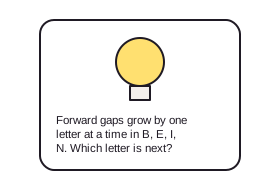
Forward gaps grow by one letter at a time in B, E, I, N. Which letter is next?
medium
Hint: The gaps are 3, 4 and 5 letters. Move forward 6 from N.
AnswerT. The forward gaps are 3, 4, 5, then 6 letters.
B to E is 3, E to I is 4, I to N is 5, and six letters after N is T.
- 80
Find the number greater than 40 and less than 50 that is even, divisible by 3, and has digits summing to 6.
medium
Hint: Only one number in the 40s has digits that add up to 6.
Answer42.
The multiples of 3 in the range are 42, 45, and 48. Only 42 is even and has digit sum 6.
- 81
Which is the largest three-digit multiple of 7?
medium
Hint: Divide 999 by 7 and look at the remainder.
Answer994.
999 / 7 is 142 remainder 5, so the largest whole multiplier is 142 and 142 x 7 = 994.
- 82
Backward gaps grow by one letter at a time in Z, W, S, N. Where do you land next?
medium
Hint: Count back from N by one more letter than last time.
AnswerH. Move back 3, then 4, then 5, then 6 letters.
N is the 14th letter; moving back 6 positions reaches the 8th letter, H.
- 83
A two-digit number has a tens digit one greater than its ones digit, and its digits total 9. What is the number?
medium
Hint: Find two neighboring digits that add up to 9.
Answer54.
If the ones digit is x, the tens digit is x + 1. Then 2x + 1 = 9, so x = 4 and the number is 54.
- 84
Find the sum of the whole numbers from 1 through 20.
medium
Hint: Pair 1 with 20, 2 with 19, and so on.
Answer210.
Pair 1 with 20, 2 with 19, and so on. Ten pairs each total 21, giving 210.
- 85
Triangular numbers begin 1, 3, 6, 10, 15. Continue the pattern once.
medium
Hint: Each step adds one more than the step before: 2, 3, 4, 5.
Answer21.
The additions are 2, 3, 4, and 5. Adding the next amount, 6, to 15 gives 21.
- 86
Tasks W, X, Y, and Z must be done once each. W is before X, Y is after X, and Z is before W. Give the only order.
medium
Hint: Z comes before W, and W before X. Where can Y go?
AnswerZ, W, X, Y.
Z precedes W, W precedes X, and X precedes Y, so the full order is forced.
- 87
A positive whole number below 20 leaves remainder 2 when divided by 3 and remainder 4 when divided by 5. Find it.
medium
Hint: List the numbers below 20 that leave 4 when divided by 5.
Answer14.
The numbers below 20 that leave remainder 4 upon division by 5 are 4, 9, 14, and 19. Their remainders upon division by 3 are 1, 0, 2, and 1, so only 14 satisfies both conditions.
- 88
Successive products form 1, 2, 6, 24, 120 by multiplying by 2, 3, 4, then 5. Extend the pattern.
medium
Hint: The next multiplier is 6.
Answer720.
The next multiplier is 6, so the next term is 120 x 6 = 720.
- 89
Talks J, K, L, and M fill slots 1 through 4. M is third, K is after M, L is before J, and L is not second. Give the order.
medium
Hint: M is third and K comes after M, so K takes slot 4.
AnswerL, J, M, K.
M occupies slot 3, so K must be slot 4. Slots 1 and 2 remain for L and J; because L is before J and is not second, L is slot 1 and J is slot 2.
- 90
Five quiz scores have mean 18. If the score 14 is removed, what is the mean of the other four?
medium
Hint: The five scores add up to 90.
Answer19.
A mean of 18 across five scores gives a total of 5 x 18 = 90. Removing 14 leaves 76, and 76 / 4 = 19.
- 91
Terms follow n times the next whole number: 2, 6, 12, 20, 30 for n from 1 through 5. Find the term for n = 6.
medium
Hint: Check the rule on the last term you have: 5 times 6 is 30.
Answer42.
For n = 6, the rule gives 6 x (6 + 1) = 6 x 7 = 42.
- 92
Exactly two of lamps A, B, C, and D are on. A and B have opposite states, C and D have opposite states, A matches C, and D is on. Which lamps are on?
medium
Hint: D is on, so C is off, and A matches C.
AnswerB and D.
D is on, so its opposite C is off. A matches C, so A is off. B is opposite A, so B is on. Therefore exactly B and D are on, satisfying the stated total of two.
- 93
Traveling at a constant 18 kilometers per hour, how far does a cyclist go in 50 minutes?
medium
Hint: 50 minutes is five sixths of an hour.
Answer15 kilometers.
Fifty minutes is 50/60 = 5/6 of an hour. Distance equals rate times time, so 18 x 5/6 = 15 kilometers.
- 94
Beginning at 12, add the digits of the current term to make the next: 12, 15, 21, 24, 30. Continue once.
medium
Hint: The digits of 30 add up to 3.
Answer33.
The shown steps add 1 + 2, then 1 + 5, then 2 + 1, then 2 + 4. The digits of 30 total 3, so 30 + 3 = 33.
- 95
A bag contains 3 red and 2 blue counters. Two are drawn without replacement. What is the probability both are red?
medium
Hint: After one red counter is drawn, how many reds are left, out of how many counters?
Answer3/10.
The first red has probability 3/5. After it is removed, the second red has probability 2/4. Multiplying gives 3/5 x 2/4 = 6/20 = 3/10.
- 96
Pair each counting number with twice itself: 1, 2, 2, 4, 3, 6, 4, 8. Which term is ninth?
medium
Hint: The terms come in pairs, and the ninth term starts a new pair.
Answer5.
The pairs are (1, 2), (2, 4), (3, 6), and (4, 8). The next pair begins with 5, so the ninth term is 5.
- 97
In a group, 18 people drink tea, 13 drink coffee, and 7 drink both. How many drink at least one of the two?
medium
Hint: The 7 who drink both were counted twice.
Answer24 people.
Adding 18 and 13 counts the 7 people in both groups twice. Subtracting that duplicate count gives 18 + 13 - 7 = 24.
Hard brain teasers
- 98
Nine coins begin tails-up. One move flips exactly two coins. Can repeated moves leave all nine heads-up?
hard
Hint: Each move changes the number of heads by 0 or by 2. Is 9 even or odd?
AnswerNo.
The number of heads changes by 2, 0, or -2, so it always stays even. Nine heads is odd.
- 99
Build a five-move word ladder from HEAD to TAIL, changing one letter per move.
hard
Hint: Change the D of HEAD first, to make a word meaning to get better.
AnswerHEAD, HEAL, TEAL, TELL, TALL, TAIL.
Each adjacent pair changes exactly one letter: D/L, H/T, A/L, E/A, then L/I.
- 100
A three-digit code obeys these exact clues: 682 has one digit correct and well placed; 614 has one correct but misplaced; 206 has two correct but misplaced; 738 has none correct; 780 has one correct but misplaced. Find the code.
hard
Hint: 738 rules out 7, 3 and 8. Then 780 tells you 0 is in the code, but not last.
Answer042.
From 738, digits 7, 3, and 8 are absent. The 780 clue then makes 0 present but not third. In 682, 2 must be the well-placed third digit or 6 must be first; the 614 misplaced clue rules out a well-placed 6, so 6 is absent and 2 is third. The 206 clue puts 0 and 2 in the code but not in positions 2 and 1, so 0 is first. In 614, 1 cannot occupy its shown second position, leaving 4 as the one correct misplaced digit in the remaining second slot.
- 101
Pages are numbered from 1 through 120. How many times is the digit 1 printed?
hard
Hint: Count the 1s in the ones place, the tens place and the hundreds place separately.
Answer53 times.
From 1 to 99 there are 20. From 100 to 120 there are 21 hundreds digits, 10 tens digits, and 2 ones digits: 20 + 21 + 10 + 2 = 53.
- 102
Describe each term aloud to obtain the next: 1, 11, 21, 1211, 111221. What follows?
hard
Hint: Read 111221 aloud in groups: three 1s, two 2s, one 1.
Answer312211.
The last shown term has three 1s, two 2s, and one 1. Writing those counts and digits in order gives 31 22 11, or 312211.
- 103
Remove two opposite corner squares from an 8 by 8 checkerboard. Can 31 dominoes, each covering two edge-sharing squares, cover what remains?
hard
Hint: Think about the colors. Which color are the two corners you removed?
AnswerNo. Opposite corners have the same color, while every domino covers one square of each color.
The board starts with 32 squares of each color. Removing same-colored corners leaves 30 of one color and 32 of the other, but 31 dominoes would cover 31 of each.
- 104
Exactly one of three suspects took a key, and exactly one statement is true. Ana says, "I did not take it." Bo says, "Ana took it." Cy says, "Bo did not take it." Who took the key?
hard
Hint: Ana's and Bo's statements cannot both be false, so one of them is the true one.
AnswerBo.
If Ana took it, Ana's statement is false while Bo's and Cy's are true, giving two truths. If Cy took it, Ana's and Cy's are true, again giving two. If Bo took it, only Ana's statement is true: Bo's accusation is false and Cy's claim is false. Therefore Bo is the sole consistent culprit.
- 105
A rectangle has positive whole-number side lengths and area 36. Which side lengths give the smallest perimeter?
hard
Hint: The closer the two sides are to each other, the shorter the way around.
Answer6 by 6, with perimeter 24.
The factor pairs are 1x36, 2x18, 3x12, 4x9, and 6x6, with perimeters 74, 40, 30, 26, and 24.
- 106
Box 1 says, "The prize is here." Box 2 says, "The prize is not here." Exactly one label is said to be true. Can either box hold the prize without breaking that rule?
hard
Hint: Put the prize in box 1, then in box 2, and count the true labels each time.
AnswerNo.
With the prize in box 1, both labels are true. With it in box 2, both labels are false.
- 107
A rectangle has positive whole-number side lengths and perimeter 22. Which dimensions give the greatest area?
hard
Hint: Length plus width is 11. Keep the two sides as close as you can.
Answer5 by 6, with area 30.
The side lengths must total 11. The possible pairs 1x10, 2x9, 3x8, 4x7, and 5x6 have areas 10, 18, 24, 28, and 30, so 5 by 6 is greatest.
- 108
Nine identical-looking coins include one heavier coin. How can a balance scale identify it in two weighings?
hard
Hint: Split the coins into three groups of three.
AnswerWeigh three against three. Keep the heavier group, or the unweighed group if they balance. Then weigh two coins from that group against each other.
The first weighing narrows nine candidates to three. The second distinguishes left, right, or the unweighed third coin.
- 109
Four people take 1, 2, 7, and 10 minutes to cross a bridge. At most two cross, they need one torch, and a pair moves at the slower person's speed. What is the least total time?
hard
Hint: Send the two slowest people across together, and let the two fastest carry the torch back.
Answer17 minutes.
Crossing the two slowest together costs at least 10. The two fastest can enable that crossing and restore the torch for 2 + 1 + 10 + 2 = 15, after which their final crossing costs 2. Sending the slowest separately costs at least 21, so 17 is minimal.
- 110
Three switches control one indicator in another room. The indicator stays warm for five minutes after it is switched off. You may enter the room once. How can you identify the controlling switch?
hard
Hint: The indicator can tell you more than on or off. Touch it.
AnswerTurn on switch 1 for several minutes, turn it off, turn on switch 2, then enter. Lit means switch 2, warm but unlit means switch 1, and cool and unlit means switch 3.
The procedure deliberately creates three distinguishable states: on, recently off, and never on.
- 111
Two unevenly burning ropes each take exactly 60 minutes to burn from one end to the other. How can they measure 45 minutes?
hard
Hint: A rope lit at both ends burns out in half the time.
AnswerLight the first rope at both ends and the second rope at one end. When the first is gone, light the other end of the second.
Burning the first rope from both ends consumes it in 30 minutes even if its rate varies along its length. The second rope then has 30 minutes of one-end burn time left; lighting its other end halves that remaining time to 15 minutes. The total is 30 + 15 = 45 minutes.
- 112
Using only an unmarked 3-liter jug and an unmarked 5-liter jug, measure exactly 4 liters.
hard
Hint: Fill the 5-liter jug and pour it into the 3-liter jug. What is left?
AnswerLeave 2 liters in the 5-liter jug, transfer them to the empty 3-liter jug, then fill the 5-liter jug and pour 1 liter into the smaller jug.
Fill the 5-liter jug and pour into the 3-liter jug, leaving 2 liters. Empty the smaller jug and move those 2 liters into it. Refill the 5-liter jug; the smaller jug needs 1 more liter, so filling it leaves exactly 4 liters in the larger jug.
- 113
Eight numbered vials include exactly one contaminant that darkens a test strip. How can three strips identify the vial in one test round?
hard
Hint: Three strips that each turn dark or stay clear give 2 times 2 times 2 patterns.
AnswerNumber the vials 0 through 7 in three-bit binary and put a drop on each strip corresponding to a 1 in the vial's code.
Three strips have 2 x 2 x 2 = 8 light-or-dark patterns. Treating dark as 1 and unchanged as 0 makes the observed three-bit pattern equal the contaminated vial's number; 000 identifies vial 0.
- 114
A traveler must ferry a fox, a hen, and grain across a river, carrying only one of them at a time. The fox cannot stay with the hen, and the hen cannot stay with the grain. Give a safe crossing plan.
hard
Hint: The hen causes all the trouble. It goes first, and it may have to come back.
AnswerTake the hen across, return alone, take the fox across, bring the hen back, take the grain across, return alone, then take the hen across.
After the first trip, the fox and grain are safe together. Swapping the fox for the hen leaves the fox with grain across the river. Moving the grain next leaves the hen alone, and the final trip reunites all three without ever leaving a forbidden pair unattended.
- 115
One hundred closed lockers are toggled on pass 1, every second locker on pass 2, every third on pass 3, and so on through pass 100. Which lockers remain open?
hard
Hint: A locker is toggled once for each number that divides it. Which numbers have an odd count of divisors?
AnswerThe ten lockers numbered by perfect squares: 1, 4, 9, 16, 25, 36, 49, 64, 81, and 100.
Locker n is toggled once for each positive divisor of n. Divisors normally pair as d and n/d, giving an even number of toggles. Only perfect squares have one unpaired divisor, their square root, so exactly the square-numbered lockers receive an odd number of toggles and finish open.
Questions about brain teasers with answers
What is the difference between a brain teaser and a riddle?
A riddle usually hides its answer in the wording. A brain teaser is a puzzle you reason or calculate your way through, such as a number pattern or a deduction.
Are the answers explained?
Yes. Every teaser has a worked answer under it, so you can check the reasoning as well as the result.
Which teasers suit children or teens?
The easy teasers at the top of this page and the kids page suit younger solvers; the teens page is pitched at middle and high school.
Can I print them for a class?
Yes. Print every teaser with its worked answer, or download the PDF or the cut-apart prompt cards for handouts.