45 classroom games for every grade Games for lesson review, brain breaks, indoor recess, the first days of school, math and spelling practice, and class parties, from kindergarten to high school. Most need only the board, paper or a soft ball.
Start with this one
Review quiz board
Players Whole class in 3 to 5 teams
Minutes 20 to 40
Ages Grades 3 to 12
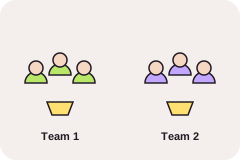
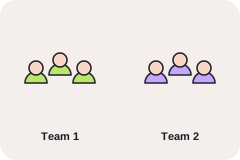
You need A classroom screen or projector, 25 review questions, and a mini whiteboard or scrap paper for each team Enter the unit's questions in five categories, with easier questions worth fewer points. Split the class into teams and give each team something to write on. A team picks a category and a value. Every team writes an answer, so no team sits out a turn. All the steps and ways to adapt it Or try Around the world or Wastebasket basketball review .
Find a game
Your group Any size 45 2 to 5 4 6 to 12 8 13 to 30 45 More than 30 43 Time Any length 45 10 minutes or less 32 10 to 20 minutes 24 20 to 40 minutes 6 Printer Any 45 No printer 17 Printer available 45
Show every game Group size, playing time and ages are suggestions to adapt to your group, not measurements. Anyone may pass a turn.
Review games Review quiz board
Players Whole class in 3 to 5 teams
Minutes 20 to 40
Ages Grades 3 to 12
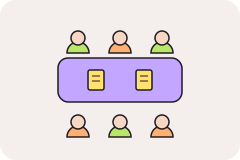
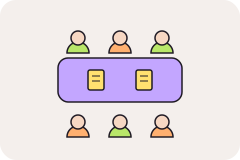
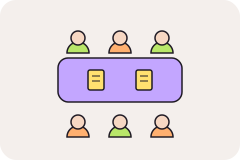
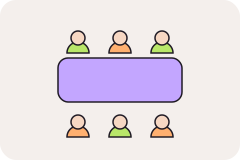
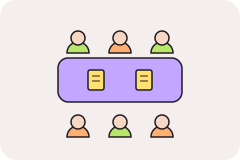
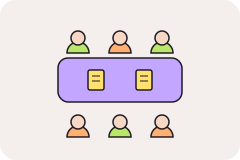
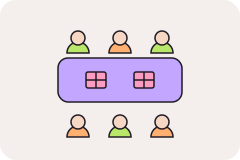
You need A classroom screen or projector, 25 review questions, and a mini whiteboard or scrap paper for each team Suggested setup: teams. Enter the unit's questions in five categories, with easier questions worth fewer points. Enter the unit's questions in five categories, with easier questions worth fewer points. Split the class into teams and give each team something to write on. A team picks a category and a value. Every team writes an answer, so no team sits out a turn. Reveal the answer. Every team that got it right scores the points. Save the board and play it again the day before the test. Around the world
Players Whole class
Minutes 10 to 15
Ages Grades 1 to 8
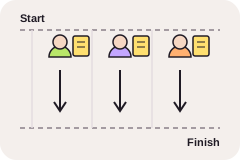
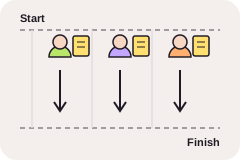
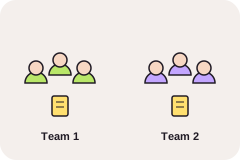
You need Flash cards or a list of quick questions with one-word answers Suggested setup: relay lanes. One student stands beside the desk of the student next to them. One student stands beside the desk of the student next to them. Show a flash card. The two students race to say the answer. The faster student moves on to the next desk, and the other student takes the seat. A student who beats every classmate and gets back to the start has gone around the world. Use math facts, sight words, state capitals or unit vocabulary. Wastebasket basketball review
Players Whole class in 2 to 4 teams
Minutes 20 to 30
Ages Grades 3 to 12
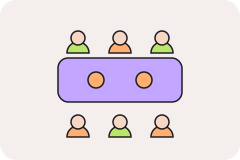
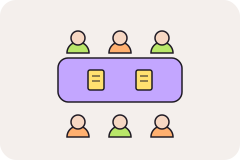
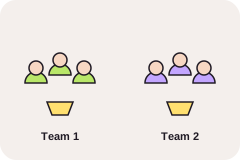
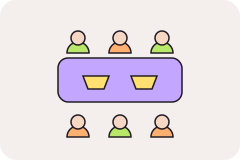
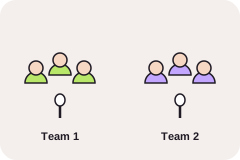
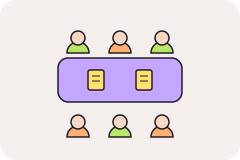
You need A wastebasket, a paper ball, tape for three lines on the floor, and review questions Suggested setup: tables. Tape three lines at growing distances from the wastebasket, worth 1, 2 and 3 points. Tape three lines at growing distances from the wastebasket, worth 1, 2 and 3 points. Ask one team a question. The team huddles and agrees on a single answer. A right answer scores 1 point and earns a shot from the line the shooter chooses. A wrong answer goes to the next team to steal. Change the shooter each turn so everyone who wants to shoot gets a turn. Four corners review
Players Whole class
Minutes 10 to 15
Ages Grades 2 to 12
You need Signs for A, B, C and D in the four corners, and multiple-choice questions Suggested setup: spread out. Tape a letter sign in each corner of the room. Tape a letter sign in each corner of the room. Show a multiple-choice question with four answers on the board. Students walk to the corner of the answer they pick. Reveal the answer and ask a student in the right corner to explain why. Nobody is out. A quick count of each corner shows what needs reteaching. Whiteboard showdown
Players Whole class, alone or in pairs
Minutes 10 to 20
Ages Grades 2 to 12
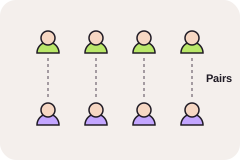
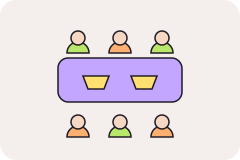
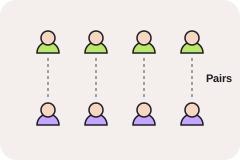
You need A mini whiteboard, or a sheet in a plastic sleeve, and a dry-erase marker for each student or pair Suggested setup: pairs. Show a question or problem on the board. Show a question or problem on the board. Everyone writes an answer and keeps it hidden. Call 'Show me', and all boards go up together. Scan the boards, give the answer, and ask a student who got it right to explain the steps. Play for points in pairs, or with no score as a quick check. Vocabulary bingo
Players Whole class
Minutes 15 to 20
Ages Grades 2 to 8
You need A different bingo card for each student, the call list, and counters Suggested setup: tables. Print a different card for each student from a science, math or language arts word set. Print a different card for each student from a science, math or language arts word set. Read a definition aloud instead of the word. Students cover the word that matches the definition. A student with a full line reads each covered word back with its meaning. One wrong match and play goes on. Without a printer: List 16 to 20 unit words on the board. Each student draws a 3 by 3 grid and copies any nine of them.
For this game: Science vocabulary bingo cards
Snowball review
Players Whole class
Minutes 10 to 15
Ages Grades 3 to 12
You need A sheet of scrap paper and a pencil for each student Suggested setup: tables. Each student writes one review question on the front of a sheet and its answer on the back. Each student writes one review question on the front of a sheet and its answer on the back. On your signal, everyone crumples the sheet and tosses it gently into the middle of the room. Each student picks up one snowball that is not their own. Students answer the question under it, then turn the sheet over to check. Toss again for a second round, or read out the hardest questions. Stand up if it's true
Players Whole class
Minutes 5 to 10
Ages Grades K to 8
You need True and false statements about the lesson Suggested setup: spread out. Read a statement about the lesson. Read a statement about the lesson. Students stand if they think it is true and stay seated if they think it is false. Give the answer with one sentence of explanation. For each false statement, ask a volunteer to change it into a true one. Hot seat
Players Whole class
Minutes 10 to 15
Ages Grades 3 to 12
You need A chair at the front with its back to the board, and a list of vocabulary words Suggested setup: teams. A volunteer sits in the chair facing the class, with the board behind them. A volunteer sits in the chair facing the class, with the board behind them. Write a vocabulary word on the board where the class can see it. Classmates raise hands and give clues without saying the word or any part of it. When the student in the chair guesses right, the student who gave the last clue takes the seat. In older grades, play in two teams with one minute per student in the chair. Draw the word
Players Whole class in 2 teams
Minutes 15 to 20
Ages Grades 1 to 12
You need Cards with unit vocabulary, the board, and markers Suggested setup: teams. Write unit words on cards, such as volcano, peninsula, fraction or adjective. Write unit words on cards, such as volcano, peninsula, fraction or adjective. A student draws a card and sketches the word on the board, with no letters or numbers. Teammates call out guesses for up to a minute. An unsolved word passes to the other team for a single guess. After each word, a student from either team gives its meaning. Without a printer: Keep the word list at your desk and show each artist the next word.
For this game: Printable drawing game cards
Scoot
Players 15 to 32 students
Minutes 20 to 30
Ages Grades 2 to 8
You need A numbered question card on every desk and a numbered answer sheet for each student Suggested setup: tables. Put one numbered question card on each desk. Put one numbered question card on each desk. Students answer the card at their desk on the matching line of their sheet. Call 'Scoot', and everyone moves to the next desk in an order you set. Allow 30 to 60 seconds per card, depending on the grade and the questions. When students are back at their own desks, go over the answers together. Without a printer: Students number a sheet of notebook paper, and each question goes on a sticky note or index card.
For this game: Printable trivia answer sheets
Beat the teacher
Players Whole class against the teacher
Minutes 5 to 15
Ages Grades 1 to 8
You need Review questions and two score columns on the board Suggested setup: tables. Draw one score column for the class and one for the teacher. Draw one score column for the class and one for the teacher. Ask a question and call on a student at random. A right answer scores a point for the class. A wrong answer scores one for the teacher. The student may ask a classmate for help once per game. The first side to reach ten points wins. Brain breaks Simon says
Players Whole class
Minutes 3 to 5
Ages Grades K to 3
You need Nothing Suggested setup: spread out. Give quick actions that start with 'Simon says', such as 'Simon says touch your toes.' Give quick actions that start with 'Simon says', such as 'Simon says touch your toes.' Students do only the actions that start with those words. A student who moves on an action without them sits out one turn, then rejoins. Speed up the actions, then let a student lead the next round. Silent ball
Players Whole class
Minutes 5 to 10
Ages Grades 1 to 8
You need A soft foam ball Suggested setup: spread out. Students stand by their desks or sit on them. From the first throw, nobody speaks. Students stand by their desks or sit on them. From the first throw, nobody speaks. Toss the ball gently to any student, who catches it and tosses it on. A student who talks, drops a fair throw or makes a throw nobody could catch sits down. Seated students watch as judges. The last three standing win the round. Heads down, thumbs up
Players Whole class
Minutes 10 to 15
Ages Grades K to 5
You need Nothing Suggested setup: spread out. Choose four to seven students to stand at the front. Choose four to seven students to stand at the front. Everyone else rests their head on the desk, eyes closed, with one thumb up. Each standing student quietly presses down one thumb, then returns to the front. Say 'Look up.' Students whose thumb was pressed stand, and each one guesses who pressed it. A right guess swaps places with the student who pressed the thumb. Four corners
Players Whole class
Minutes 5 to 10
Ages Grades K to 5
You need The numbers 1 to 4 posted in the corners Suggested setup: spread out. One student stands in the middle, closes their eyes and counts slowly to ten. One student stands in the middle, closes their eyes and counts slowly to ten. Everyone else walks quietly to a corner. With eyes still closed, the counter calls out a corner number. Students in that corner go back to their seats for the rest of the game. The last student standing counts in the next game. Zip, zap, boing
Players 10 to 35 in a circle
Minutes 5 to 10
Ages Grades 2 to 12
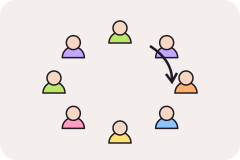
You need Space to stand in a circle Suggested setup: circle. Stand in a circle. The first player says 'zip' and points to the next person on the right. Stand in a circle. The first player says 'zip' and points to the next person on the right. 'Zip' always goes to the next person in the same direction. 'Zap' sends it across the circle to anyone, with a point and eye contact. 'Boing' bounces it back to the person who sent it, who must send it somewhere else. A student who hesitates or says the wrong word starts the next round. Nobody is out. Count to twenty
Players Whole class
Minutes 3 to 5
Ages Grades 3 to 12
You need Nothing Suggested setup: spread out. The class counts aloud from 1 to 20, one voice at a time. The class counts aloud from 1 to 20, one voice at a time. There is no set order, and nobody may signal who goes next. If two students say a number at the same moment, the count goes back to 1. A class that reaches 20 tries for 30 next time. Would you rather, on your feet
Players Whole class
Minutes 5 to 10
Ages Grades K to 8
You need A list of either-or questions Suggested setup: spread out. Read a would you rather question and point to one side of the room for each choice. Read a would you rather question and point to one side of the room for each choice. Students walk to the side they choose. Ask one volunteer from each side for a reason. Add a way of moving each round, such as hopping, tiptoeing or walking like a crab. For this game: Would you rather questions for kids
Freeze dance
Players Whole class
Minutes 3 to 5
Ages Grades K to 3
You need Music you can pause Suggested setup: spread out. Play music while students dance beside their desks. Play music while students dance beside their desks. Pause the music, and every dancer freezes on the spot. Before the next pause, call out a shape to freeze in, such as a tree, the letter T or a sleeping cat. Nobody is out. End with a slow song to bring the class back to calm. Rock, paper, scissors cheer tournament
Players Whole class
Minutes 5
Ages Grades 1 to 12
You need Nothing Suggested setup: tables. Students pair off and play a single throw of rock, paper, scissors. Students pair off and play a single throw of rock, paper, scissors. Whoever loses joins the winner's cheering section, walking behind them and chanting their name. Each winner looks for another winner. The loser of that match brings their whole cheering section over to the new winner. The final throw is between two students, each with half the class cheering behind them. Brain teaser warm-up
Players Whole class, alone or in pairs
Minutes 5
Ages Grades 3 to 8
You need One brain teaser on the board Suggested setup: pairs. Put one brain teaser on the board before students come in. Put one brain teaser on the board before students come in. Give two minutes of silent thinking, then two minutes with a partner. Invite one pair to explain their reasoning before you show the answer. For this game: Brain teasers for kids with answers
Riddle of the day
Players Whole class
Minutes 5
Ages Grades K to 6
You need A riddle on the board and sticky notes Suggested setup: tables. Write one riddle on the board in the morning. Write one riddle on the board in the morning. Students write their answer on a sticky note and add it to a spot by the door. Read out the answer and its explanation before lunch or dismissal. For this game: School riddles with answers
Indoor recess games Classroom charades
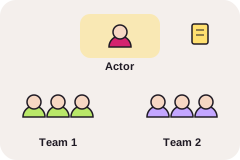
Players Whole class in 2 teams
Minutes 15 to 20
Ages Grades K to 8
You need A list of things to act out, and a timer Suggested setup: one player at the front. A student takes a prompt card and mimes it for the class, with no talking. A student takes a prompt card and mimes it for the class, with no talking. The actor's team gets one minute to call out the answer. In kindergarten, the whole class guesses together. Use animals, sports and everyday actions for young grades, and book titles or historical events for older ones. Rotate actors so every student who wants a turn gets one. For this game: Charades for kids
Telephone
Players 10 to 30 in a line or circle
Minutes 5 to 10
Ages Grades K to 5
You need Nothing Suggested setup: spread out. The first student whispers a sentence once to the next student. The first student whispers a sentence once to the next student. Each student passes it on in a whisper, once only. The last student says aloud what they heard. The first student then says the original sentence, and the class compares the two. Use a sentence from the lesson to show how information changes as it is passed along. Hangman or spaceman
Players Whole class, or pairs
Minutes 5 to 10
Ages Grades 1 to 8
You need The board, or a sheet for each pair Suggested setup: tables. Draw one blank line for each letter of a word or phrase. Draw one blank line for each letter of a word or phrase. The class calls out letters, one guess per turn. A right letter goes on every line where it belongs. A wrong letter adds one part to a drawing of a spaceman. The class wins by solving the word before the drawing is complete. Without a printer: Draw the blank lines and the spaceman on the board or any paper.
For this game: Printable hangman sheets
Dots and boxes
Players Pairs
Minutes 10
Ages Grades 1 to 8
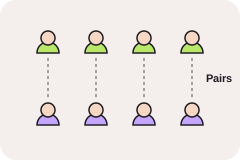
You need A dot grid and two colored pencils for each pair Suggested setup: tables. Players take turns joining two neighboring dots with a line, across or down. Players take turns joining two neighboring dots with a line, across or down. Drawing the fourth side of a box wins it: write your initial inside and draw another line. When every box is closed, the player with more boxes wins. Bigger grids make longer games for older students. Without a printer: Draw a grid of 5 by 5 dots on any paper.
For this game: Printable dots and boxes
First days and team building Find a classmate who
Players 15 to 35
Minutes 10 to 15
Ages Grades 2 to 12
You need A find-a-classmate card and a pencil for each student Suggested setup: tables. Give each student a card of squares, such as 'has a pet', 'likes to draw' or 'read a book this summer'. Give each student a card of squares, such as 'has a pet', 'likes to draw' or 'read a book this summer'. Students walk around and find a classmate who fits each square. The classmate signs the square. Each name may appear only once on a card. Anyone can say 'pass' to a question without explaining. After ten minutes, ask a few students to share one thing they learned. Without a printer: Write eight prompts on the board. Students number a sheet from 1 to 8 and collect a name for each.
For this game: Human bingo
Name and motion
Players 10 to 35 in a circle
Minutes 10
Ages Grades K to 8
You need Space to stand in a circle Suggested setup: circle. The first student says their name and makes a movement, such as a wave or a jump. The first student says their name and makes a movement, such as a wave or a jump. The whole class repeats the name and the movement together. Go around the circle until everyone has had a turn. At the end, ask a volunteer to point to three classmates and do each one's name and movement. Silent line-up
Players Whole class
Minutes 5 to 10
Ages Grades 2 to 12
You need Space for one long line Suggested setup: spread out. Ask the class to line up in alphabetical order by first name, without a word. Ask the class to line up in alphabetical order by first name, without a word. Students can use gestures and fingers, but no voices and no writing. When the line is done, students say their names from one end to check. For a second round, line up by birthday, month and day, with January 1 at one end. Two truths and a lie
Players Whole class
Minutes 15 to 20
Ages Grades 4 to 12
You need An index card for each student Suggested setup: tables. Each student writes three short statements about themselves: two true and one made up. Each student writes three short statements about themselves: two true and one made up. Keep statements to hobbies, places and skills, nothing private. A student reads their three aloud, and the class votes on which is the lie. The student reveals the lie. Go around as time allows, over several days if needed. For review, use three statements about the unit instead. For this game: Two truths and a lie ideas
Paper tower challenge
Players Whole class in teams of 3 or 4
Minutes 20 to 25
Ages Grades 3 to 12
You need 20 sheets of paper and 12 inches of tape per team, and a tape measure Suggested setup: teams. Give every team the same paper and tape. Give every team the same paper and tape. Teams have 12 minutes to build the tallest tower that stands on its own. Measure each tower when time is up. It must stand for ten seconds without help. Ask each team what they would change, then give them a second try if time allows. Math games Buzz
Players Whole class
Minutes 5 to 10
Ages Grades 2 to 8
You need Nothing Suggested setup: tables. Choose a number, such as 3. Students count aloud around the room, one number each. Choose a number, such as 3. Students count aloud around the room, one number each. Any multiple of the chosen number is replaced by the word 'buzz'. A student who says the number instead sits down, and the next student carries on the count. Change the number to practice other times tables. For older grades, say 'fizz' for multiples of 3, 'buzz' for multiples of 5 and 'fizz buzz' for multiples of both. Mystery number
Players Whole class
Minutes 5 to 10
Ages Grades 1 to 6
You need A number from 1 to 100 written where nobody can see it Suggested setup: spread out. Choose a number from 1 to 100 and keep it hidden. Choose a number from 1 to 100 and keep it hidden. Students ask yes-or-no questions, such as 'Is it even?' or 'Is it more than 50?' Cross out ruled-out numbers on a hundreds chart as you go. Count the questions. Halving the choices each time always finds the number in seven questions or fewer. Math facts bingo
Players Whole class
Minutes 15 to 20
Ages Grades 2 to 5
You need A number bingo card for each student, a list of math facts, and counters Suggested setup: tables. Print a different 1 to 75 number card for each student. Print a different 1 to 75 number card for each student. Call a math fact instead of a number, such as '9 times 8' or '100 minus 37'. Students work out the answer and cover it if it is on their card. Write each fact and its answer on the board so a win can be checked. Keep every answer between 1 and 75 so it can appear on a card. Without a printer: Students draw a 4 by 4 grid and fill it with any 16 numbers from 1 to 30. Call facts with answers in that range.
For this game: Number bingo card generator: 75 or 90
Race to 100
Players Pairs or groups of 3
Minutes 10 to 15
Ages Grades 1 to 4
You need Two dice and a sheet of paper for each group Suggested setup: relay lanes. Players take turns rolling two dice and adding the total to their score. Players take turns rolling two dice and adding the total to their score. Each player writes the new total every turn, and the others check it. Whoever passes 100 first wins. In grades 3 and 4, multiply the two dice instead and race to 500. Without a printer: Use any dice, or number cards 1 to 6 drawn from a cup.
For this game: Printable dice net
Math war
Players Pairs
Minutes 10 to 15
Ages Grades 1 to 5
You need A deck of cards with the face cards taken out, for each pair Suggested setup: tables. Deal the cards evenly, face down. Aces count as 1. Deal the cards evenly, face down. Aces count as 1. Both players turn over two cards and add them. The higher total wins all four cards. On a tie, each player turns over two more. Play until time is up. The player with more cards wins. Subtract or multiply the two cards instead for older grades. Math riddle relay
Players Whole class in teams of 4
Minutes 15 to 20
Ages Grades 3 to 8
You need The same set of printed math riddles for each team, face down at the front Suggested setup: teams. Stack each team's riddles face down at the front, in the same order. Stack each team's riddles face down at the front, in the same order. One runner per team brings back the first riddle, and the team solves it together. The runner takes the answer to the teacher. If it is right, the runner collects the next riddle. Change the runner each time. The first team through the set wins. Without a printer: Write the riddles on the board one at a time and let teams write answers on scrap paper.
For this game: Math riddles with answers
Word and spelling games Sparkle
Players 10 to 30
Minutes 10
Ages Grades 1 to 8
You need A spelling list Suggested setup: circle. Students stand in a circle or by their desks. Students stand in a circle or by their desks. Say a spelling word. Students spell it one letter each, in order. A student who gives a wrong letter sits down, and the next student tries that letter. After the last letter, the next student says 'Sparkle', and the student after that sits down. Keep going until a few students are left standing. Stop, the categories game
Players Whole class
Minutes 10 to 15
Ages Grades 3 to 12
You need Paper and a pencil for each student, and five categories Suggested setup: tables. Write five categories on the board, such as an animal, a country, a verb, a food and a word from this unit. Write five categories on the board, such as an animal, a country, a verb, a food and a word from this unit. Choose a letter at random. Students write one word for each category that starts with that letter. The first student to finish calls 'Stop', and everyone puts pencils down. Score 2 points for a word nobody else wrote and 1 point for a word someone else also wrote. Word ladders
Players Alone or in pairs
Minutes 10
Ages Grades 2 to 8
You need A printed word ladder and a pencil for each student Suggested setup: pairs. Start with the top word, such as cold, and finish at the bottom word, such as warm. Start with the top word, such as cold, and finish at the bottom word, such as warm. Change one letter at a time to make a real word on each rung: cold, cord, card, ward, warm. Compare routes with a partner. The shortest route wins. Without a printer: Write the start and end words on the board, with blank lines between them.
For this game: Printable word ladder worksheets
Class party games One-minute challenge stations
Players Whole class in teams of 4 or 5
Minutes 20 to 30
Ages Grades K to 8
You need Plastic cups, cotton balls, two bowls, a spoon and a timer Suggested setup: teams. Set up four stations with one task each, such as stacking 10 cups into a pyramid or moving cotton balls between bowls with a spoon. Set up four stations with one task each, such as stacking 10 cups into a pyramid or moving cotton balls between bowls with a spoon. Teams rotate between stations. Each task lasts one minute. Only tasks completed inside the minute score. Add up the tasks each team finished. For this game: One-minute party games
Class party bingo
Players Whole class
Minutes 15 to 20
Ages Grades K to 5
You need A holiday or season bingo set: a card for each student, the caller's list, and counters Suggested setup: tables. Pick the set that matches the party, such as Halloween, winter or spring. Pick the set that matches the party, such as Halloween, winter or spring. Call each word slowly, and hold up a picture or write the word for early readers. The first full line wins a small prize, such as choosing the next song. Keep playing until several students have won. Without a printer: Draw a 3 by 3 grid on the board. Students copy it and fill it with nine words from the list you read out.
Class trivia showdown
Players Whole class in 4 to 6 teams
Minutes 20 to 30
Ages Grades 2 to 6
You need Trivia questions for kids and scrap paper for each team Suggested setup: teams. Give each team a name and a sheet to write answers on. Give each team a name and a sheet to write answers on. Read a question twice. Teams agree on one answer and write it down. Check the answers after every five questions. Keep a running score on the board and end with a tie-break question. For this game: Trivia questions for kids with answers
Estimation jar
Players Whole class
Minutes 5, plus the reveal at the end of the party
Ages Grades K to 8
You need A clear jar of small items you have counted, and sticky notes Suggested setup: tables. Fill a jar with something small, such as erasers or buttons, counting as you go. Fill a jar with something small, such as erasers or buttons, counting as you go. Students write their name and a guess on a sticky note. Line up the notes on the board from lowest to highest guess. Reveal the count. The closest guess wins, and the class works out how far off each guess was. Timer and team scores Seconds per turn Turns in the session
8 turns × 60 seconds = 8 minutes of play, plus instructions and breaks.
60
Start Pause Reset
Pause whenever the group needs more time.
Teams2 3 4 5 6 Team Lime's turn
Next team Team Lime: 0
Team Lime +1 Team Lime −1 Team Violet: 0
Team Violet +1 Team Violet −1 Team Tangerine: 0
Team Tangerine +1 Team Tangerine −1 Team Sky: 0
Team Sky +1 Team Sky −1 Team Lemon: 0
Team Lemon +1 Team Lemon −1 Team Bubblegum: 0
Team Bubblegum +1 Team Bubblegum −1
More to choose from