21 party games for seniors
Games for a senior center, an activity hour or a family party, every one playable sitting down, with time to answer.
Start with this one
Large-print bingo
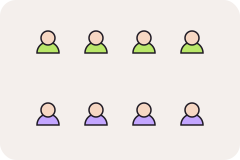
- Players
- 4 to 40
- Minutes
- 20 to 30
- Ages
- Older adults
- You need
- A large-print card for each player, the call list, and big markers such as poker chips or bottle caps
- Hand out cards and markers that are easy to pick up.
- Call each item slowly, twice, facing the room, and write it on a board as you go.
- Give everyone time to look before the next call. A helper can sit beside anyone who wants one.
All the steps and ways to adapt itOr try Classic number bingo or Trivia for seniors.
Group size, playing time and ages are suggestions to adapt to your group, not measurements. Anyone may pass a turn.
Bingo and quizzes
Large-print bingo
- Players
- 4 to 40
- Minutes
- 20 to 30
- Ages
- Older adults
- You need
- A large-print card for each player, the call list, and big markers such as poker chips or bottle caps
Suggested setup: two facing lines. Hand out cards and markers that are easy to pick up. - Hand out cards and markers that are easy to pick up.
- Call each item slowly, twice, facing the room, and write it on a board as you go.
- Give everyone time to look before the next call. A helper can sit beside anyone who wants one.
- Check a win by reading the board back aloud.
Without a printer: Draw a 3 by 3 grid with a thick marker for each player and fill it with words from the call list in large letters.
For this game: Large print senior bingo
Classic number bingo
- Players
- 4 to 60
- Minutes
- 30 to 45
- Ages
- Older adults
- You need
- A different 75-number card for each player, the caller's list, and markers
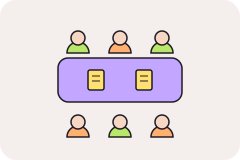 Suggested setup: tables. Print a different card for each player, in large print if the group needs it.
 - Print a different card for each player, in large print if the group needs it.
- Call each number with its letter, such as 'B, 7', and say it twice.
- Mark each number on the caller's list as you call it.
- Agree on the winning pattern before each game: a line, four corners or a full card.
- Play several short games so more players win.
Without a printer: Use a boxed bingo set if the group has one.
For this game: Number bingo card generator: 75 or 90
Trivia for seniors
- Players
- 6 to 40, in teams
- Minutes
- 20 to 30
- Ages
- Older adults
- You need
- Trivia questions for older adults, pens, and one answer sheet for each table
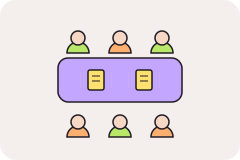 Suggested setup: tables. Seat players at tables of four to six. Each table is a team.
 - Seat players at tables of four to six. Each table is a team.
- Read each question slowly, twice, with the answer options if there are any.
- Allow a full minute before moving on.
- Read the answers at the end of each round and add up the scores.
For this game: Trivia questions for seniors
Decades quiz
- Players
- 6 to 40, in teams
- Minutes
- 20 to 30
- Ages
- Older adults
- You need
- Decades questions, notepaper, and pens
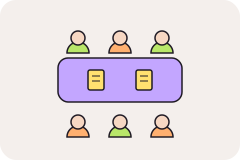 Suggested setup: tables. Pick questions from the decades your group grew up in.
 - Pick questions from the decades your group grew up in.
- Read a question and let each table talk it over before writing an answer.
- After each answer, invite anyone who remembers the event to say a few words about it.
- Keep score, or skip the scoring and let the talk run.
For this game: Decades trivia questions from the 50s to the 2010s
Word and memory games
Finish the saying
- Players
- 4 to 30
- Minutes
- 10 to 15
- Ages
- Older adults
- You need
- A list of well-known sayings
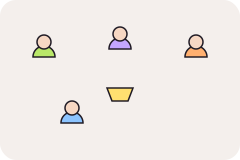 Suggested setup: spread out. Read the first half of a saying, such as 'A penny saved...' or 'Don't count your chickens...'
 - Read the first half of a saying, such as 'A penny saved...' or 'Don't count your chickens...'
- The group calls out the ending together: '...is a penny earned', '...before they hatch'.
- Ask who used to say it at home, for anyone who wants to share.
- More to use: 'The early bird...', 'Too many cooks...', 'Where there's a will...'
Guess the song
- Players
- 4 to 30
- Minutes
- 15 to 20
- Ages
- Older adults
- You need
- A speaker and a playlist of songs from the group's younger years
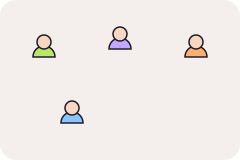 Suggested setup: spread out. Ask the group ahead of time which singers and decades they like.
 - Ask the group ahead of time which singers and decades they like.
- Play the first ten seconds of a song.
- Players call out the title or the singer. Play more of the song if nobody knows it.
- Let the song play on for anyone who wants to sing along.
Riddle round
- Players
- 4 to 30
- Minutes
- 10 to 15
- Ages
- Older adults
- You need
- A list of riddles, in large print if players will read them
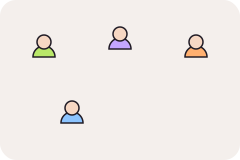 Suggested setup: spread out. Read a riddle slowly, twice.
 - Read a riddle slowly, twice.
- Give the group a full minute to think, and offer a hint if nobody has it.
- Read the answer and its explanation.
For this game: Riddles for seniors with answers
Memory tray
- Players
- 4 to 20
- Minutes
- 10 to 15
- Ages
- Older adults
- You need
- A tray, 10 to 12 everyday objects, a cloth, and paper and thick pens
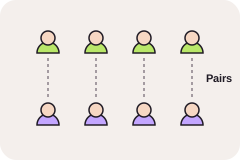 Suggested setup: pairs. Place everyday objects on a tray, such as a thimble, a key, a teaspoon, a comb and a clothespin.
 - Place everyday objects on a tray, such as a thimble, a key, a teaspoon, a comb and a clothespin.
- Walk the tray around so everyone can see it up close for a minute.
- Cover it. Players write or say as many objects as they recall. Working in pairs is fine.
- Uncover the tray and go through the objects together.
A to Z together
- Players
- 4 to 30
- Minutes
- 10 to 15
- Ages
- Older adults
- You need
- A large board or flip chart, and a marker
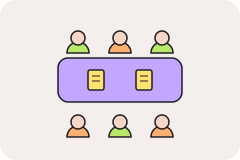 Suggested setup: tables. Choose a topic, such as flowers, cities, foods or first names.
 - Choose a topic, such as flowers, cities, foods or first names.
- Write A to Z down the side of the board.
- The group calls out one answer for each letter while you write it in.
- Skip hard letters such as Q and X and come back to them at the end.
- The group plays as one team, so nobody is put on the spot.
Old prices guessing game
- Players
- 4 to 30
- Minutes
- 15
- Ages
- Older adults
- You need
- An old catalog, newspaper page or advertisement that shows prices, and paper and pens
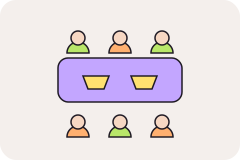 Suggested setup: tables. Choose eight to ten items from the old page, such as a loaf of bread, a radio or a movie ticket.
 - Choose eight to ten items from the old page, such as a loaf of bread, a radio or a movie ticket.
- Say the year the page is from, then read out each item without its price.
- Players write down what they think it cost then.
- Reveal each price. The closest guess scores, and the group compares it with what the item costs today.
What is it? object pass
- Players
- 4 to 20
- Minutes
- 15 to 20
- Ages
- Older adults
- You need
- Five or six old household objects, such as a hand egg beater, a darning egg or a shoe stretcher
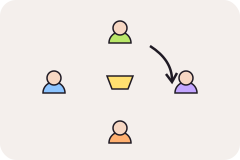 Suggested setup: circle. Pass one object around the circle so everyone can hold it.
 - Pass one object around the circle so everyone can hold it.
- Players guess what it is and how it was used.
- Someone who knows explains, or the host tells the group.
- Invite anyone who used one to say where and when.
Large-print word search
- Players
- Any number
- Minutes
- 15 to 20
- Ages
- Older adults
- You need
- A large-print word search and a thick pen for each player
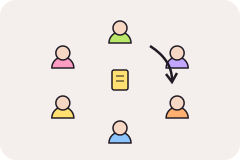 Suggested setup: circle. Choose a topic the group likes, such as gardening or birds.
 - Choose a topic the group likes, such as gardening or birds.
- Turn on large print before printing.
- Players circle words at their own pace, alone or with a neighbor.
- The answer key prints with the puzzle, so players can check their own.
Without a printer: Show the puzzle on a large TV and let the group find words together while you circle them.
Seated active games
Seated balloon volleyball
- Players
- 6 to 20
- Minutes
- 15 to 20
- Ages
- Older adults
- You need
- A balloon or a light beach ball, chairs in two facing rows, and a ribbon for a net
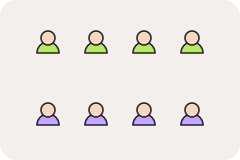 Suggested setup: two facing lines. Set two rows of chairs facing each other, with a ribbon stretched across the middle at head height.
 - Set two rows of chairs facing each other, with a ribbon stretched across the middle at head height.
- Players stay seated and tap the balloon over the ribbon with a hand or a pool noodle.
- A team scores a point when the balloon lands on the other side.
- Use chairs without wheels, and lock wheelchair brakes.
- For a gentler game, the whole group counts how many taps it can make before the balloon touches the floor.
Seated bowling
- Players
- 4 to 16
- Minutes
- 20 to 30
- Ages
- Older adults
- You need
- Ten plastic pins or empty plastic bottles, a light ball, and a score sheet
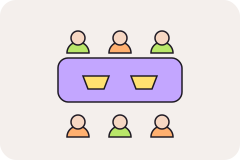 Suggested setup: tables. Set the pins in a triangle six to ten feet from the bowler's chair.
 - Set the pins in a triangle six to ten feet from the bowler's chair.
- Each player rolls twice per turn from a seated position.
- A helper resets the pins and calls out how many fell.
- Score one point per pin, or keep a simple team total.
Without a printer: Keep score on a whiteboard in large numbers.
For this game: Printable team score sheet
Bean bag toss
- Players
- 4 to 20
- Minutes
- 15 to 20
- Ages
- Older adults
- You need
- Six bean bags and a target, such as a laundry basket, a bucket or a board with holes
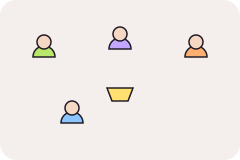 Suggested setup: spread out. Place the target four to six feet from the throwers' chairs.
 - Place the target four to six feet from the throwers' chairs.
- Players get three bean bags on each turn.
- Score a point for each bag that lands in the target.
- Move the target closer or farther for each player so everyone has a fair chance.
Parachute ball
- Players
- 8 to 20
- Minutes
- 10 to 15
- Ages
- Older adults
- You need
- A play parachute and a light ball
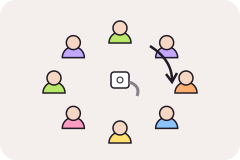 Suggested setup: circle. Players sit in a circle and hold the edge of the parachute.
 - Players sit in a circle and hold the edge of the parachute.
- Place a light ball in the middle.
- Together, lift and lower the parachute to roll the ball around the edge or bounce it up.
- Try to roll the ball once around the whole circle without it falling off.
Dice, card and table games
Bunco
- Players
- 8 to 12, at tables of four
- Minutes
- 45 to 60
- Ages
- Older adults
- You need
- Three dice per table, a score sheet for each player, and a bell for the head table
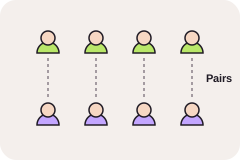 Suggested setup: pairs. Play six rounds. The target number is 1 in round one, 2 in round two, and so on.
 - Play six rounds. The target number is 1 in round one, 2 in round two, and so on.
- Partners sit across from each other. On a turn, roll three dice, score 1 point for each die showing the target, and keep rolling while you score.
- Three of the target number is a bunco, worth 21 points. Three of any other number is worth 5.
- The round ends when a pair at the head table reaches 21 points and rings the bell.
- Winning pairs move toward the head table, and players switch partners for the next round.
Without a printer: Draw six boxes, one per round, on a card for each player.
For this game: Printable Bunco score sheets
Horse race dice game
- Players
- 4 to 30
- Minutes
- 20 to 30
- Ages
- Older adults
- You need
- Two large dice, and a race track on poster board with lanes numbered 2 to 12, each ten spaces long
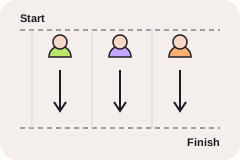 Suggested setup: relay lanes. Each player picks a horse number to cheer for. Several players can share a horse.
 - Each player picks a horse number to cheer for. Several players can share a horse.
- Players take turns rolling both dice.
- The horse with the number of the total moves forward one space.
- The first horse to reach the finish wins. Run several races.
- A total of 7 comes up most often, so give horses 2 and 12 a head start if you like.
Five dice
- Players
- 2 to 6
- Minutes
- 30 to 45
- Ages
- Older adults
- You need
- Five dice, a cup, and a score sheet for each player
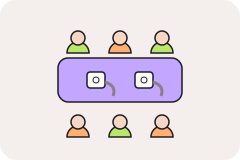 Suggested setup: tables. On a turn, roll all five dice. Keep any you like and roll the rest, up to three rolls in all.
 - On a turn, roll all five dice. Keep any you like and roll the rest, up to three rolls in all.
- After the last roll, choose one empty box on your score sheet and fill it in.
- Each box can be used only once, even if it scores zero.
- After 13 turns every box is full. The highest total wins.
Without a printer: Copy the box names from a score sheet onto lined paper.
For this game: Printable five dice score sheets
Gin rummy
- Players
- 2
- Minutes
- 30 to 45
- Ages
- Older adults
- You need
- A deck of cards, large-print if you have one, and a score sheet
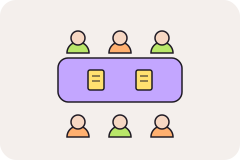 Suggested setup: tables. Deal ten cards each. Turn the next card face up to begin a discard pile.
 - Deal ten cards each. Turn the next card face up to begin a discard pile.
- On a turn, take the top card of the deck or of the discard pile, then discard one.
- Build sets of three or four of the same rank, and runs of three or more in the same suit.
- Knock when your unmatched cards add up to 10 or less, or go gin with every card matched.
- Score the difference in unmatched cards, and play to an agreed total.
Without a printer: Keep score on a notepad in two columns.
For this game: Printable gin rummy score sheets
Dominoes
- Players
- 2 to 4
- Minutes
- 20 to 30
- Ages
- Older adults
- You need
- A double-six set of dominoes, or printed domino cards
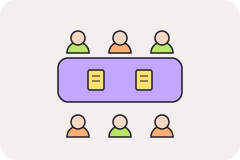 Suggested setup: tables. Place the dominoes face down and mix them. Each player takes seven.
 - Place the dominoes face down and mix them. Each player takes seven.
- The player with the highest double places it in the middle.
- Take turns adding a domino with a matching number to either open end.
- If you cannot play, draw from the leftover pile, or pass if there is none.
- The first player out of dominoes wins the round.
Without a printer: Use a regular set. Jumbo dominoes with large dots are easier to see.
For this game: Printable domino cards
Timer and team scores
8 turns × 60 seconds = 8 minutes of play, plus instructions and breaks.
60
Pause whenever the group needs more time.
Team Lime's turn
Team Lime: 0
Team Violet: 0
Team Tangerine: 0
Team Sky: 0
Team Lemon: 0
Team Bubblegum: 0
