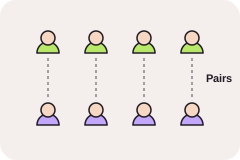
20 family party games for all ages Games that young children, teens, parents and grandparents can play together at family game night, a holiday gathering or a reunion. When a game needs reading, pair a younger child with an older partner.
Start with this one
Family charades
Players 4 to 20, in 2 teams
Minutes 20 to 30
Ages 5 and up
You need Slips of paper with things to act out, a bowl, and a timer Mix easy prompts, such as brushing teeth or a kangaroo, with harder ones, such as film or book titles. Mark the easy slips with a star so young children can pick from those. The actor mimes for up to a minute while their own team calls out guesses. All the steps and ways to adapt it Or try Draw and guess or Survey game .
Find a game
Your group Any size 20 2 to 5 15 6 to 12 19 13 to 30 15 More than 30 2 Time Any length 20 10 minutes or less 4 10 to 20 minutes 16 20 to 40 minutes 9 Printer Any 20 No printer 7 Printer available 20
Show every game Group size, playing time and ages are suggestions to adapt to your group, not measurements. Anyone may pass a turn.
Family game night Family charades
Players 4 to 20, in 2 teams
Minutes 20 to 30
Ages 5 and up
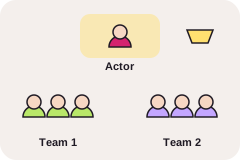
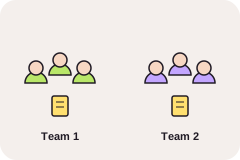
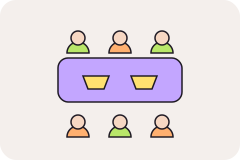
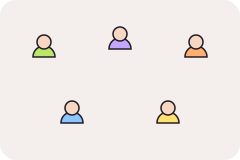
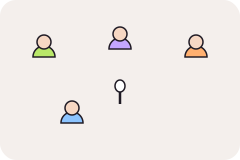
You need Slips of paper with things to act out, a bowl, and a timer Suggested setup: one player at the front. Mix easy prompts, such as brushing teeth or a kangaroo, with harder ones, such as film or book titles. Mix easy prompts, such as brushing teeth or a kangaroo, with harder ones, such as film or book titles. Mark the easy slips with a star so young children can pick from those. The actor mimes for up to a minute while their own team calls out guesses. Teams take turns, and a tally on paper keeps the score. Draw and guess
Players 4 to 16, in 2 teams
Minutes 20 to 30
Ages 6 and up
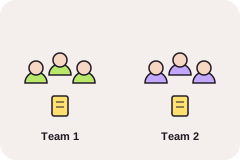
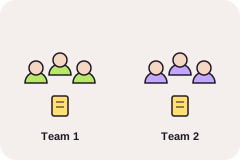
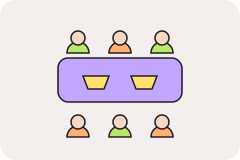
You need Paper or a whiteboard, markers, a timer, and a word list Suggested setup: teams. Deal words by difficulty: easy ones for young artists, harder ones for teens and adults. Deal words by difficulty: easy ones for young artists, harder ones for teens and adults. The artist draws without letters, numbers or talking. Teammates get a minute to name it, and the other team then has a single guess to steal. Let a young child and a grandparent draw as a pair. For this game: Drawing game word generator
Survey game
Players 6 to 20, in 2 teams
Minutes 20 to 30
Ages 8 and up
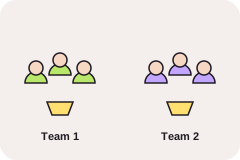
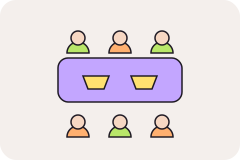
You need Survey prompts with ranked answers, a board to write answers on, and a bell or a table to slap Suggested setup: teams. Each team sends a player to the front. Read a prompt, such as 'Name something you take to the beach.' Each team sends a player to the front. Read a prompt, such as 'Name something you take to the beach.' The first to ring or slap gives an answer. The team with the higher-ranked answer takes control. That team gives more answers, one player at a time. Three wrong answers give the other team one chance to steal. The team that fills the board, or makes the steal, wins the points on it. Play five prompts. The higher score wins. For this game: Survey game questions and answers
Family trivia
Players 4 to 20, in mixed-age teams
Minutes 20 to 30
Ages 7 and up
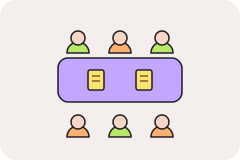
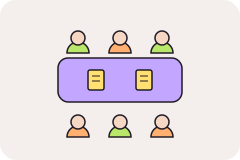
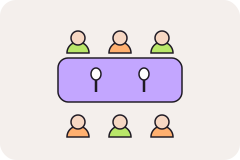
You need Family trivia questions, paper, and pens Suggested setup: tables. Build teams with a child, a teen and an adult on each, where you can. Build teams with a child, a teen and an adult on each, where you can. After the team agrees, its youngest player gives the answer. Read the answer and its source after every question. Play three rounds of eight questions. For this game: Family trivia questions
Quiz board for all generations
Players 4 to 20, in 2 or 3 teams
Minutes 30 to 40
Ages 8 and up
You need A TV or laptop screen Suggested setup: teams. Open the board on the TV so everyone can see the categories. Open the board on the TV so everyone can see the categories. Each team in turn names a category and a point value. Teammates confer and settle on one answer. If it is wrong, the next team gets a try. The board keeps score. The highest total wins. Don't say it
Players 6 to 20, in 2 teams
Minutes 20 to 30
Ages 10 and up
You need Cards with a word at the top and three banned words below it, and a timer Suggested setup: teams. Write cards such as 'pizza' with the banned words 'cheese', 'slice' and 'Italian'. Write cards such as 'pizza' with the banned words 'cheese', 'slice' and 'Italian'. The clue giver describes the top word without saying it or any of its banned words. Their team guesses as many cards as it can in one minute. A player from the other team watches the card and buzzes if a banned word is said. Without a printer: Write the cards on index cards or scraps of paper.
For this game: Printable blank playing cards
Who am I? sticky notes
Players 4 to 20
Minutes 15 to 20
Ages 7 and up
You need Sticky notes and a marker Suggested setup: tables. Write a famous person, a character or an animal on each note. Write a famous person, a character or an animal on each note. Stick one on each player's forehead without letting them see it. Players take turns asking yes-or-no questions about their own note, such as 'Am I an animal?' Keep asking until you get a no, then the next player asks. Keep playing until everyone has guessed who they are. Twenty questions
Players 2 to 15
Minutes 10
Ages 6 and up
You need Nothing Suggested setup: spread out. One player thinks of an object. One player thinks of an object. The others ask up to 20 yes-or-no questions, starting broad: 'Is it bigger than a shoebox?' Count the questions aloud as you go. Name the object within 20 questions to win. If the questions run out, the same player chooses again. For this game: 20 questions game
Name, place, animal, thing
Players 3 to 10
Minutes 15 to 20
Ages 8 and up
You need A sheet of paper and a pen per player Suggested setup: tables. Each player draws four columns: name, place, animal and thing. Each player draws four columns: name, place, animal and thing. One player recites the alphabet silently until another says 'stop'. That letter starts the round. Everyone fills each column with a word that starts with that letter. The first to finish calls 'Stop', and pens go down. Score 10 points for an answer nobody else wrote and 5 for a shared one. Young children can team up with an adult. Story chain
Players 3 to 15
Minutes 10
Ages 5 and up
You need Nothing Suggested setup: circle. Sit in a circle. The first player starts a story with one sentence. Sit in a circle. The first player starts a story with one sentence. Each player adds one sentence in turn. For a harder round, add one word at a time. The player who ends the story says 'The end.' Holiday gatherings and reunions Find a relative who
Players 10 to 60
Minutes 15 to 20
Ages 6 and up
You need A find-a-relative card and a pen for each guest Suggested setup: tables. Make squares that fit different relatives, such as 'was born in another state', 'can whistle a tune' or 'has met a great-grandparent'. Make squares that fit different relatives, such as 'was born in another state', 'can whistle a tune' or 'has met a great-grandparent'. Relatives move around the room looking for someone who matches each square. The matching relative signs that square, and a card may carry each relative's name just once. Children who cannot write yet collect initials with a parent's help. The first full row wins, and any relative may decline a question. Without a printer: Read out ten prompts. Guests number a paper plate or napkin and collect a name for each.
For this game: Human bingo
Who knows the family
Players 10 to 60, in teams
Minutes 20 to 30
Ages 8 and up
You need 15 questions about family history, answer sheets, and pens Suggested setup: tables. Before the gathering, ask older relatives for facts, such as where they met or what the first family car was. Before the gathering, ask older relatives for facts, such as where they met or what the first family car was. Split the room into teams that mix branches of the family. Read each question, and teams write their answers. After each answer, let the relative it is about tell the story. Without a printer: Each team writes the numbers 1 to 15 down the side of a plain sheet.
For this game: Printable trivia answer sheets
Two truths and a lie: family stories
Players 6 to 30
Minutes 15 to 20
Ages 8 and up
You need Nothing Suggested setup: spread out. A relative tells three short stories from their life: two true, one invented. A relative tells three short stories from their life: two true, one invented. The room votes on which one is made up. The teller reveals the invented one. Children can each ask one question about the true stories. For this game: Two truths and a lie ideas
One-minute family challenges
Players 4 to 20
Minutes 20 to 30
Ages 5 and up
You need Plastic cups, cotton balls, a spoon, two bowls, balloons, and a timer Suggested setup: spread out. Pick three or four one-minute tasks, such as stacking cups into a pyramid or keeping two balloons in the air. Pick three or four one-minute tasks, such as stacking cups into a pyramid or keeping two balloons in the air. Give young children an easier version, such as six cups instead of ten. Players or teams take turns while the rest of the family cheers. Score a point for each task finished in time. For this game: One-minute party games
Card, dice and board games Spoons
Players 4 to 10
Minutes 15 to 20
Ages 7 and up
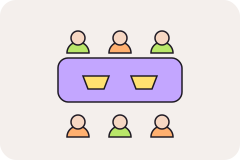
You need One deck of cards, and enough spoons for everyone but one player Suggested setup: tables. Deal four cards each and put the spoons in the middle. Deal four cards each and put the spoons in the middle. Everyone passes one card to the left at the same time, trying to collect four of a kind. For young players, a pair is enough to take a spoon. When one spoon goes, everyone grabs. The player without one gets a letter from the word SPOON. Anyone who spells the whole word is out. The last player in wins. Crazy eights
Players 2 to 6
Minutes 15 to 20
Ages 6 and up
You need A deck of playing cards Suggested setup: tables. Deal five cards to each player, or seven each with two players, and flip the next card to start a face-up pile. Deal five cards to each player, or seven each with two players, and flip the next card to start a face-up pile. On a turn, play a card that matches the top card's suit or number. An eight can be played at any time, and the player names the next suit. If you cannot play, draw from the deck until you can. Whoever plays their last card first wins the hand. Pig
Players 2 to 10
Minutes 15
Ages 6 and up
You need A single die, and a scorepad Suggested setup: spread out. On your turn, keep rolling the die for as long as you dare, keeping a running total. On your turn, keep rolling the die for as long as you dare, keeping a running total. Say 'hold' to bank the running total on the scorepad and pass the die. A roll of 1 wipes out that turn's running total, and the die moves on. First to bank 100 points wins. Mancala
Players 2
Minutes 10 to 20
Ages 6 and up
You need A mancala board, and 48 small stones, beans or buttons Suggested setup: spread out. Put four stones in each of the 12 small pits. Each player owns the six pits on their side and the store on their right. Put four stones in each of the 12 small pits. Each player owns the six pits on their side and the store on their right. On a turn, pick up all the stones in one of your pits and drop one in each pit counterclockwise, including your own store but not your opponent's. If your last stone lands in your store, take another turn. If it lands in an empty pit on your side, move it and the stones in the pit opposite into your store. When one side is empty, the other player stores the stones left on their side. The most stones wins. Without a printer: Use an egg carton for the pits and two bowls for the stores.
For this game: Printable mancala board
Active games Sardines
Players 5 to 20
Minutes 20 to 30
Ages 5 and up
You need A house, with off-limits rooms agreed in advance Suggested setup: pairs. One player hides. Everyone else counts to 50 together, then searches. One player hides. Everyone else counts to 50 together, then searches. A seeker who finds the hider squeezes into the spot with them, quietly. Young children search with an adult partner. The last seeker to find the group hides next. Balloon keep-up
Players 3 to 20
Minutes 5 to 10
Ages 3 and up
You need A balloon, and a room cleared of breakables Suggested setup: spread out. Tap the balloon into the air. The family counts every tap out loud. Tap the balloon into the air. The family counts every tap out loud. Nobody may tap it twice in a row. If it touches the floor, start again from zero. Try to beat the family record each time you play. Timer and team scores Seconds per turn Turns in the session
8 turns × 60 seconds = 8 minutes of play, plus instructions and breaks.
60
Start Pause Reset
Pause whenever the group needs more time.
Teams2 3 4 5 6 Team Lime's turn
Next team Team Lime: 0
Team Lime +1 Team Lime −1 Team Violet: 0
Team Violet +1 Team Violet −1 Team Tangerine: 0
Team Tangerine +1 Team Tangerine −1 Team Sky: 0
Team Sky +1 Team Sky −1 Team Lemon: 0
Team Lemon +1 Team Lemon −1 Team Bubblegum: 0
Team Bubblegum +1 Team Bubblegum −1
More to choose from