36 party games for kids

Party games for kids sorted by age, from 3-year-olds to 12-year-olds, plus printable games for kids to play at the party or at home. For children under 5, choose short games where nobody is out.

Updated

Group size, playing time and ages are suggestions to adapt to your group, not measurements. Anyone may pass a turn.

Games for ages 3 to 5

Musical statues

Players
4 to 20
Minutes
5 to 10
Ages
3 to 6
You need
Music you can pause
  1. Start the music and let everyone dance however they like.
  2. Cut the music without warning. Dancers hold their pose like statues.
  3. A child who wobbles joins you as a judge and helps spot the next wobbler.
  4. With 3- and 4-year-olds, nobody becomes a judge: cheer the silliest frozen pose instead.

Pass the parcel

Players
5 to 20
Minutes
10 to 15
Ages
3 to 7
You need
A small prize under layers of wrapping paper, one layer per child with a sticker tucked into each, and music
  1. Seat everyone in a ring on the floor.
  2. While the music plays, the parcel travels from hand to hand around the ring.
  3. Each time the music cuts out, whoever holds the parcel rips away one layer and takes the sticker.
  4. Watch the parcel and cut the music so that each child gets one layer.
  5. The last layer reveals the prize for the child who opens it.

Hot potato

Players
5 to 20
Minutes
5
Ages
3 to 6
You need
A beanbag or a soft toy, and music
  1. Sit in a ring and hand the 'hot potato' on as fast as you can while the music plays.
  2. The child caught holding it when the music stops picks a silly action for everyone to do, such as roaring like a lion.
  3. Nobody sits out. Restart the music and keep passing.

Duck, duck, goose

Players
6 to 20
Minutes
10
Ages
3 to 6
You need
Grass or floor space for a ring of children
  1. Seat the children in a ring, facing the middle.
  2. The picker walks around the outside, patting each head and saying 'duck'.
  3. Saying 'goose' on a head starts the chase: the goose leaps up and runs after the picker.
  4. The picker tries to sit in the goose's empty place before being tagged. Whoever is left standing picks next.

Simon says

Players
4 to 20
Minutes
5
Ages
3 to 6
You need
Nothing
  1. Let the birthday child be Simon for the first round.
  2. Simon calls out actions, such as 'Simon says wiggle your fingers.' Children do only the ones that begin with 'Simon says'.
  3. Anyone who copies a plain action, such as 'Jump!', sits down for one turn.
  4. Give a new child the Simon role every few minutes.

Sleeping lions

Players
5 to 25
Minutes
5 to 10
Ages
3 to 7
You need
Floor space to lie down
  1. Everyone lies flat on the floor with eyes closed and pretends to be a sleeping lion.
  2. Choose one or two lion keepers. They walk around telling jokes and making silly noises to get a lion to twitch, but they may not touch.
  3. A lion who moves or laughs gets up and helps the keepers.
  4. Whoever stays asleep longest is the winner. Use it when the room needs to calm down.

Color hunt

Players
3 to 15
Minutes
10
Ages
3 to 5
You need
A room or yard with plenty of colorful things
  1. Call out a color, such as red.
  2. Children find something that color and touch it or bring it back.
  3. Cheer every find, then call the next color.
  4. For older preschoolers, call two features at once, such as 'something blue and soft'.

Animal moves

Players
3 to 20
Minutes
5 to 10
Ages
3 to 6
You need
A list of animals
  1. Call out an animal, such as a frog.
  2. Children cross the room the way it moves: hopping, slithering, stomping or flapping.
  3. Children can add the animal's sound as they go.
  4. Let the children take turns choosing the next animal.

Open the material: Animal charades ideas

Picture bingo

Players
4 to 20
Minutes
15
Ages
3 to 7
You need
A different picture card per child, the list of calls, and small counters
  1. Hand each child a card and a cup of counters, such as buttons or cereal pieces.
  2. Say each word and hold up its picture so non-readers can play.
  3. Children cover the matching picture on their card.
  4. The first full row wins a small prize. Keep going so more children win.

Without a printer: Draw simple pictures in a 3 by 3 grid on paper for each child.

Open the material: Picture bingo cards with words

Games for ages 5 to 8

Musical chairs

Players
5 to 15
Minutes
10 to 15
Ages
5 to 9
You need
Chairs set back to back in a line, one fewer than the players, and music
  1. While the music plays, the children march around the line of chairs.
  2. The moment it stops, each child sits on the closest empty chair. Sitting, not pushing, is the rule.
  3. The child without a seat pulls out one chair and becomes your music helper.
  4. Play until one child sits on the last chair.

Red light, green light

Players
4 to 20
Minutes
10
Ages
4 to 9
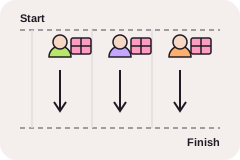
You need
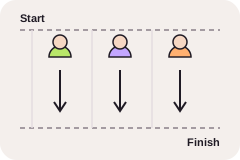
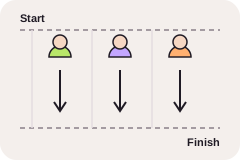
A start line and a finish line about 30 feet apart
  1. Pick one child to be the stoplight. They stand at the finish line with their back to the group.
  2. 'Green light' means go. The others move toward the stoplight.
  3. 'Red light' means stop. The stoplight spins around, and anyone still moving walks back to the start.
  4. The first child to tap the stoplight's shoulder becomes the next stoplight.

What's the time, Mr. Wolf?

Players
5 to 20
Minutes
10
Ages
4 to 8
You need
A yard or large room, with a home line at one end
  1. Mr. Wolf stands at the far end, facing away from the group, who wait on the home line.
  2. Together the children ask, 'What's the time, Mr. Wolf?' The wolf replies with an hour, such as 'four o'clock'.
  3. Everyone takes that many steps forward, and the question is asked again.
  4. At 'Dinner time!', the wolf spins around and chases them home. The child tagged is the new wolf.

Mother, may I?

Players
4 to 15
Minutes
10 to 15
Ages
5 to 8
You need
A start line and space for a dozen giant steps
  1. One child, the mother, faces the others from about 30 feet away.
  2. Children take turns asking for a move, such as 'Mother, may I take three giant steps?'
  3. The mother answers 'Yes, you may' or offers something else: 'No, but you may take two baby steps.'
  4. A child who moves without asking 'Mother, may I?' goes back to the start.
  5. The first child to reach the mother takes the mother's place.

Doggy, doggy, where's your bone?

Players
5 to 20
Minutes
10
Ages
4 to 8
You need
A chair, and a small object to be the bone, such as a toy or a beanbag
  1. One child is the dog and sits on a chair facing away, with the bone under the chair.
  2. Point to a child, who creeps up, takes the bone and hides it behind their back. Everyone else puts their hands behind their backs too.
  3. The group chants, 'Doggy, doggy, where's your bone? Someone took it from your home.'
  4. The dog turns around and has three guesses. The child who had the bone is the next dog.

Pin the tail on the donkey

Players
4 to 20
Minutes
10 to 15
Ages
3 to 8
You need
A big donkey picture with no tail, a paper tail per child with tape on it, a blindfold, and a pen
  1. Put the donkey on a wall at the children's height and write a name on every tail.
  2. Each child in turn wears the blindfold, spins around once with your help, and walks to the wall.
  3. They press their tail where they think it belongs, then look at the result.
  4. When everyone has had a go, the tail nearest the right spot wins.
  5. Children who would rather not wear the blindfold can simply close their eyes.

Without a printer: Sketch a donkey without a tail on poster paper. A rough outline works.

Clue treasure hunt

Players
3 to 15
Minutes
20 to 30
Ages
5 to 10
You need
Six to ten clue cards, and a treasure such as the party favor bags
  1. Start from the treasure's hiding place and work backward, so each clue sends the children to the spot where the next clue waits.
  2. Give the group the first clue and let them work it out together.
  3. Hand the clue-reading job around so each child gets one.
  4. For children who cannot read yet, draw the next hiding place instead of writing a clue.
  5. The final clue leads to the treasure, with a share for every child.

Without a printer: Write each clue by hand on a slip of paper.

Open the material: Scavenger hunt riddles and hiding clues

Piñata

Players
5 to 20
Minutes
15
Ages
4 to 10
You need
A piñata filled with wrapped treats or small toys, a stick, a blindfold, and an adult to hold the rope
  1. Hang the piñata outdoors, away from windows. An adult holds the rope and can raise or lower it.
  2. Keep the waiting children well back, in a wide circle, while one child swings.
  3. Youngest first: each child gets three swings, with or without the blindfold.
  4. When it breaks, give each child a bag and share the treats out evenly.

Balloon knees relay

Players
8 to 20, in 2 teams
Minutes
10
Ages
5 to 10
You need
A balloon for each team and a marker to turn around
  1. Split the children into two lines at the start.
  2. The first child in each line squeezes a balloon between their knees and waddles to the marker and back.
  3. They pass the balloon to the next child. A dropped balloon is picked up, and the child carries on.
  4. The first line to finish wins.
  5. Collect the pieces of any popped balloon right away, since they are a choking hazard for young children.

Freeze tag

Players
6 to 20
Minutes
10
Ages
5 to 10
You need
Open space with clear edges
  1. Choose one or two taggers.
  2. A child who is tagged freezes on the spot.
  3. Another player unfreezes them with a high five.
  4. Switch taggers every few minutes, or when everyone is frozen.

Limbo

Players
4 to 20
Minutes
10
Ages
5 and up
You need
A broom handle or a pool noodle, two grown-ups to hold it, and music
  1. The grown-ups hold the pole level, starting at about the shoulder height of the tallest child.
  2. One by one, children bend backward and shuffle under it without touching it or putting hands on the ground.
  3. Once everyone has been under, drop the pole a few inches.
  4. Children who touch the pole become the cheering crowd. Keep going until one child is left.

Kids charades

Players
4 to 20
Minutes
15
Ages
5 to 10
You need
Prompts such as animals, jobs and everyday actions
  1. Whisper a prompt, such as a cat, a firefighter or brushing teeth, to one child.
  2. The child acts it out with no words while the others shout guesses. Animal sounds are allowed for the youngest.
  3. Whoever guesses right acts next, or chooses someone who has not had a turn.

Open the material: Charades for kids

Riddle round

Players
4 to 20
Minutes
10
Ages
6 to 10
You need
A list of riddles for kids
  1. Read each riddle twice, slowly.
  2. Children put a hand up to answer rather than calling out.
  3. No answer after half a minute? Give a hint.
  4. Read the answer and why it works before moving on.

Games for ages 8 to 12

Kids trivia quiz

Players
4 to 20, in teams
Minutes
15 to 20
Ages
8 to 12
You need
Trivia questions for kids, paper, and pencils
  1. Split the children into teams of three or four.
  2. Read a question. Each team whispers and writes down one answer.
  3. Reveal the answer after each question and keep a tally.
  4. Give every team a small prize at the end, with the winners choosing first.

Open the material: Trivia questions for kids with answers

Draw and guess

Players
4 to 16
Minutes
15
Ages
7 to 12
You need
Paper or a whiteboard, markers, and a word list
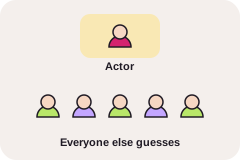
  1. A child takes a word and draws it without letters or numbers.
  2. The others guess. When someone gets it, that guesser and the artist each earn a point.
  3. Give each artist one minute.
  4. Mix easy words, such as rocket or snowman, with a few hard ones, such as homework or echo.

Open the material: Drawing game word generator

Scavenger hunt checklist

Players
6 to 20, in teams of 3
Minutes
20 to 30
Ages
6 to 12
You need
A list of things to find, and a bag for each team
  1. Write a list of things to find, such as something round, a leaf, a sock, something older than you and something that makes a noise.
  2. Split the children into teams of three, and set a time limit and the rooms or yard they can use.
  3. Teams collect each item, or take a photo of anything too big to carry.
  4. When time is up, teams show their finds. The longest list of finds wins, and the most unusual find breaks a tie.

Without a printer: Read the list aloud and let each team copy it onto paper.

Open the material: Printable scavenger hunt checklist

Paper airplane contest

Players
4 to 20
Minutes
20
Ages
7 to 12
You need
Printer paper, markers, and tape to mark a throwing line
  1. Give each child two sheets of paper and ten minutes to fold and decorate a plane.
  2. Children throw from the line, one at a time.
  3. Mark where each plane lands with a strip of tape carrying the child's name.
  4. Give prizes for the farthest flight, the best loop and the best decoration.

Would you rather for kids

Players
3 to 20
Minutes
10
Ages
6 to 12
You need
A list of would you rather questions for kids
  1. Read a question, such as 'Would you rather be able to talk to dogs or be able to fly?'
  2. Children point left for the first choice or right for the second.
  3. Ask one child from each side to say why.

Open the material: Would you rather questions for kids

Memory tray

Players
3 to 15
Minutes
10
Ages
6 to 12
You need
A tray, 10 to 15 small objects, a cloth, and paper and pencils
  1. Put small things on a tray: a toy car, a spoon, a crayon, a hair clip, a button.
  2. Let the children look for one minute, then cover the tray.
  3. Each child writes or draws as many objects as they can remember.
  4. For a second round, secretly take one object away and ask which one is missing.

Printable games for kids

Tic-tac-toe

Players
Pairs
Minutes
5
Ages
4 and up
You need
A printed sheet of grids and two colored pencils
  1. One player uses X and the other uses O.
  2. Take turns marking one empty square.
  3. Three in a row, across, down or diagonally, wins.
  4. Move to the next grid on the sheet and swap who goes first.

Without a printer: Draw two lines down and two lines across on any paper.

Open the material: Printable tic tac toe sheets

Dots and boxes

Players
Pairs
Minutes
10
Ages
6 and up
You need
A dot grid sheet and two colors
  1. Take turns drawing a short line to link two dots that are next to each other.
  2. If your line finishes a box, color it in with your color and go again.
  3. The player who has colored more boxes at the end wins.

Without a printer: Make a 4 by 4 grid of dots with a pencil.

Open the material: Printable dots and boxes

Mazes

Players
Any number
Minutes
5 to 15
Ages
4 and up
You need
A printed maze and a pencil for each child
  1. Pick a small maze for young children and a large one for older children.
  2. Children draw a route from the way in to the way out without going through a wall.
  3. Check the finished maze against its answer page.

Without a printer: Show a maze on a tablet and let the child trace it with a finger.

Open the material: Printable mazes with solutions

Animal word search

Players
Any number
Minutes
10 to 15
Ages
6 and up
You need
A printed word search and a pencil or crayon
  1. Children circle each word from the list in the grid.
  2. Younger children can search alongside an older partner.
  3. Check against the answer key.
  4. Pick another topic the children like for the next puzzle.

Without a printer: Solve the puzzle on screen by selecting the letters.

Open the material: Animals word search

Memory matching cards

Players
2 to 5
Minutes
10 to 15
Ages
3 and up
You need
A printed set of picture pairs, cut into cards
  1. Lay all the cards face down in rows.
  2. On a turn, flip two cards. If they match, keep them and go again.
  3. If not, turn them back face down in the same spot.
  4. When all the pairs are found, the player with the most wins.

Without a printer: Draw simple pictures twice each on index cards.

Open the material: Printable memory matching cards

Paper fortune teller

Players
Pairs
Minutes
15 to 20
Ages
6 to 12
You need
A printed fortune teller or a square of paper, and colored pencils
  1. Fold the fortune teller along the lines.
  2. Write funny fortunes under the flaps, such as 'You will find a lost sock' or 'Do a silly dance.'
  3. A friend picks a color and a number, and you open and close the teller that many times.
  4. Read the fortune under the flap they choose.

Without a printer: Cut a square from any sheet and fold it by hand.

Open the material: Printable paper fortune teller

Sea battle

Players
Pairs
Minutes
15 to 20
Ages
7 and up
You need
Two printed grids and a pencil for each player
  1. Each player secretly draws ships on their own grid: one of 4 squares, two of 3 and three of 2.
  2. Players take turns naming a square by its letter and number, such as D7.
  3. The other player answers 'hit' or 'miss', and you record the shot on your second grid.
  4. A ship sinks when all its squares are hit. The first to sink the whole fleet wins.

Without a printer: Rule two 10 by 10 grids and mark the columns A to J and the rows 1 to 10.

Open the material: Printable sea battle grids

Logic puzzles for kids

Players
Alone or in pairs
Minutes
10 to 15
Ages
7 to 12
You need
A printed logic puzzle and a pencil
  1. Read all the clues first.
  2. Mark an X in the grid when a clue rules something out, and a check when you know a match.
  3. Keep going until every person has one match.
  4. Read the explanation to see how each clue helps.

Without a printer: Read the clues aloud and solve them together on a grid sketched on paper.
Open the material: Logic puzzles for kids with answers

Plan the round and team scores

8 turns × 60 seconds = 8 minutes of play, plus instructions and breaks.

60

These are adjustable house rules. Pause whenever the group needs more time.

Team 1: 0

Team 2: 0