Run a quick whodunit, a mystery without a murder for younger players, scavenger, treasure and photo hunts, or a homemade escape room.
Start with this one
Murder in the dark
Players
6 to 15
Minutes
15 to 30
Ages
12 and up
You need
A deck of cards, and rooms that are safe to walk in with the lights low
Clear the floor of anything to trip on. Take one card per player, including the ace of spades and the king of hearts, and let everyone draw one in secret.
The ace is the culprit and stays secret. The king is the detective and says so.
The detective leaves the room and the lights go down. Players walk about; the culprit taps a victim on the shoulder, who counts to five and screams.
Group size, playing time and ages are suggestions to adapt to your group, not measurements. Anyone may pass a turn.
Murder mystery games
Murder in the dark
Players
6 to 15
Minutes
15 to 30
Ages
12 and up
You need
A deck of cards, and rooms that are safe to walk in with the lights low
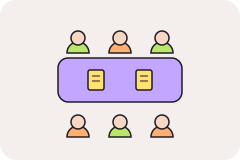
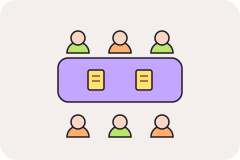
Suggested setup: tables. Clear the floor of anything to trip on. Take one card per player, including the ace of spades and the king of hearts, and let everyone draw one in secret.
Clear the floor of anything to trip on. Take one card per player, including the ace of spades and the king of hearts, and let everyone draw one in secret.
The ace is the culprit and stays secret. The king is the detective and says so.
The detective leaves the room and the lights go down. Players walk about; the culprit taps a victim on the shoulder, who counts to five and screams.
Lights on. The detective comes back and questions everyone. Only the culprit may lie.
The detective gets two accusations to find the culprit.
Wolves and villagers
Players
8 to 20
Minutes
20 to 45
Ages
10 and up
You need
A role card for each player, and a host who does not play
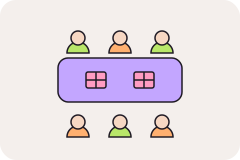
Suggested setup: tables. Deal secret roles: two or three wolves, one seer, and villagers for everyone else.
Deal secret roles: two or three wolves, one seer, and villagers for everyone else.
Night: everyone closes their eyes. The host wakes the wolves to point at one player, then wakes the seer to point at a suspect and shows a thumb up for a wolf or down for a villager.
Day: everyone opens their eyes. The host names the player the wolves chose, and the group debates and votes one suspect out.
Players who are out show their card and watch in silence.
Villagers win when every wolf is out. The wolves win when they equal the villagers.
Without a printer: Use a deck of cards: face cards for wolves, a joker for the seer and number cards for villagers.
An empty cake plate, three or four grown-up suspects, and planted clues
Suggested setup: spread out. Before the children arrive, the cake goes missing. Plant clues that point to one suspect: crumbs by the back door, frosting on an apron, a torn shopping list.
Before the children arrive, the cake goes missing. Plant clues that point to one suspect: crumbs by the back door, frosting on an apron, a torn shopping list.
Give each suspect a short alibi. Only the guilty one has an alibi with a hole in it.
The children search for clues and question the suspects.
They name the thief and explain the clues. The thief brings out the real cake.
Yes-or-no mystery stories
Players
3 to 15
Minutes
10 to 20
Ages
10 and up
You need
A list of puzzling situations with their explanations
Suggested setup: spread out. The host reads a short puzzling situation, such as a driver going the wrong way down a one-way street while an officer watches and does nothing.
The host reads a short puzzling situation, such as a driver going the wrong way down a one-way street while an officer watches and does nothing.
Players ask questions that can be answered yes, no or it does not matter.
The host answers only with those words.
The round ends when someone explains the whole situation. In the example, the driver was walking.
A list of photo tasks with points, and a phone per team
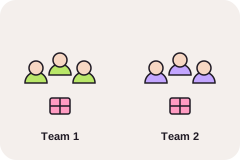
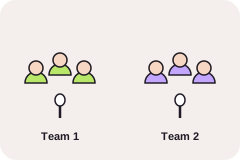
Suggested setup: teams. Write 20 photo tasks worth 1 to 5 points, such as the whole team inside one shadow, a sign with your team's initial, or a copy of a famous painting's pose.
Write 20 photo tasks worth 1 to 5 points, such as the whole team inside one shadow, a sign with your team's initial, or a copy of a famous painting's pose.
Set a play area and a return time. Late teams lose points.
Teams take the photos and send them to the host.
Show the best photos on a TV while the host adds up the points.
Treasure map hunt
Players
2 to 10
Minutes
20 to 30
Ages
4 to 9
You need
A hand-drawn map of the house or yard, and a small treasure
Suggested setup: tables. Draw a simple map of the house or yard showing the main furniture, trees and doors.
Draw a simple map of the house or yard showing the main furniture, trees and doors.
Mark an X where the treasure is hidden, and draw a dotted path with three stops on the way.
Leave a sticker for each child at every stop.
Children follow the map, collect the stickers and find the treasure.
Crumple the map or tear its edges to make it look old.
Bring it back race
Players
6 to 30, in teams
Minutes
10 to 15
Ages
4 and up
You need
A list of things most homes have
Suggested setup: teams. Teams sit in separate spots, with the host in the middle.
Teams sit in separate spots, with the host in the middle.
The host calls an item, such as a spoon, a sock or something that starts with P.
Each team sends one runner to find it and bring it to the host.
The first runner back scores a point for their team. Everyone takes a turn running.
Escape room and code games
Homemade escape room
Players
3 to 8
Minutes
45 to 60
Ages
10 and up
You need
A box or bag closed with a combination lock, four puzzles in envelopes, and a timer
Suggested setup: spread out. Set the lock to a four-digit code. Each puzzle gives one digit.
Set the lock to a four-digit code. Each puzzle gives one digit.
Make four puzzles: a word scramble, a logic puzzle, a number hidden in a picture, and a riddle whose answer is an object in the room.
Put each puzzle in an envelope. Leave the first one out, and hide the rest so that each solution leads to the next envelope.
Start a 45-minute timer. Players may ask for three hints.
Players open the lock with the full code and find the prize inside.
Without a printer: Write the scrambled words and the riddle by hand, and read a logic puzzle aloud from a phone.
Suggested setup: tables. Write each message in a simple code, such as moving every letter three places along the alphabet: A becomes D, and HELLO becomes KHOOR.
Write each message in a simple code, such as moving every letter three places along the alphabet: A becomes D, and HELLO becomes KHOOR.
Give players the first message and a hint about how the code works.
Each decoded message says where to find the next one.
The last message names the hiding place of the prize.
Timer and team scores
8 turns × 60 seconds = 8 minutes of play, plus instructions and breaks.