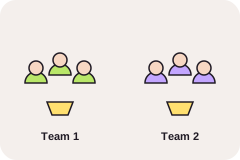
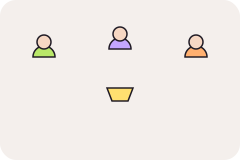
Group size, playing time and ages are suggestions to adapt to your group, not measurements. Anyone may pass a turn.
Backyard games for kids
Egg and spoon race
Players
2 to 12 at a time
Minutes
10
Ages
4 and up
You need
A spoon and an egg per player: hard-boiled, plastic, or a small potato
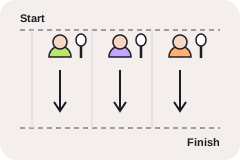
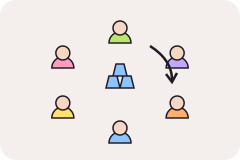
Suggested setup: relay lanes. Players line up at the start with the egg on the spoon.
Players line up at the start with the egg on the spoon.
On go, they walk or run to the finish, holding only the spoon handle.
A dropped egg goes back on the spoon where it fell before the player moves on.
The first to cross the finish with the egg on the spoon wins.
For older players, hold the spoon handle in the teeth instead, one spoon per player.
Three-legged race
Players
2 to 8 pairs at a time
Minutes
10
Ages
6 and up
You need
A soft scarf or bandana per pair, and a flat, grassy course
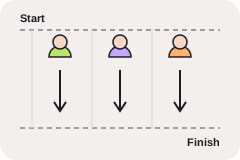
Suggested setup: relay lanes. Partners stand side by side and tie their inside ankles together loosely.
Partners stand side by side and tie their inside ankles together loosely.
Pair children of a similar height.
Let pairs practice a few steps, calling out tied leg, outside leg.
On go, pairs race to the finish.
A pair who falls gets up and carries on.
Sack race
Players
2 to 8 at a time
Minutes
10
Ages
4 and up
You need
A burlap sack or an old pillowcase per player, and a short, grassy course
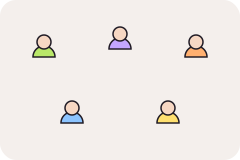
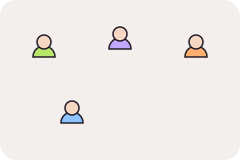
Suggested setup: spread out. Players step into their sacks and hold the top edge at waist height.
Players step into their sacks and hold the top edge at waist height.
On go, they hop to the finish line.
A player who falls gets up and keeps hopping.
The first to cross the line wins.
Red light, green light
Players
4 to 30
Minutes
10 to 15
Ages
4 and up
You need
An open space with a start line
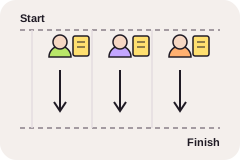
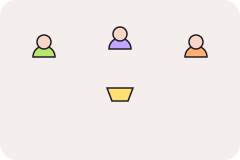
Suggested setup: relay lanes. One player is the light and stands at the far end, facing away.
One player is the light and stands at the far end, facing away.
When the light calls green light, everyone moves forward.
At red light, the light turns around and everyone must freeze.
Anyone caught moving goes back to the start.
The first to tag the light becomes the next light.
Capture the flag
Players
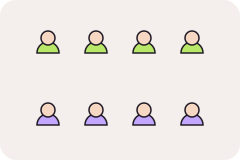
10 to 30, in two teams
Minutes
20 to 40
Ages
8 and up
You need
Two flags or bandanas, cones to mark a middle line and two jails, and a large yard or park
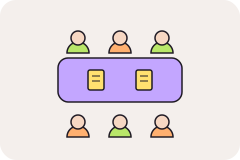
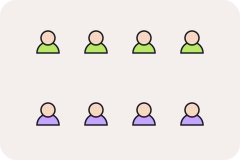
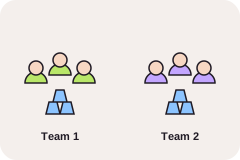
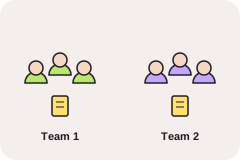
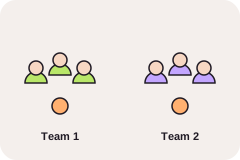
Suggested setup: teams. Split the space in half, with each team's flag at the back of its own half.
Split the space in half, with each team's flag at the back of its own half.
Players try to carry the other team's flag back to their own side.
A player tagged in the other team's half goes to that team's jail.
A teammate can free a jailed player by tagging them, and both walk back to their own side.
The first team to bring the other flag home wins.
Tug of war
Players
6 to 20, in two teams
Minutes
10
Ages
6 and up
You need
A thick rope, a bandana tied at its middle, and soft grass
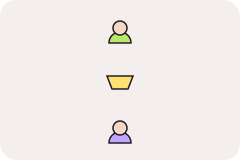
Suggested setup: teams. Mark a center line on the ground and lay the rope so the bandana sits over it.
Mark a center line on the ground and lay the rope so the bandana sits over it.
Make the two teams about equal in size and strength.
On go, both teams pull.
A team wins when the bandana crosses an agreed distance onto its side.
Hold the rope with hands only; never wrap it around a hand or body.
Backyard obstacle course
Players
2 to 20
Minutes
20 to 30
Ages
4 and up
You need
Things you already have: hoops, cones, a blanket to crawl under, a pool noodle to jump over, a ball and a bucket
Suggested setup: spread out. Lay out 6 to 8 stations in a loop.
Lay out 6 to 8 stations in a loop.
Walk the course once to show what to do at each station.
Players go one at a time while someone times them.
Let younger players skip a station or take a shortcut.
Run it again and let each player try to beat their own time.
Nature scavenger hunt
Players
2 to 20, alone or in teams
Minutes
20 to 30
Ages
4 and up
You need
A checklist and a pencil per team
Suggested setup: teams. List things to find: a round stone, a feather, something yellow, a leaf with jagged edges, a bird, a cloud shaped like an animal.
List things to find: a round stone, a feather, something yellow, a leaf with jagged edges, a bird, a cloud shaped like an animal.
Set the edges of the play area.
Teams tick off each find by pointing to it, without picking plants or disturbing animals.
The team with the most finds when time is up wins.
Without a printer: Copy the list by hand onto a sheet for each team, or read each item aloud as the hunt goes on.
Five large dice, or normal dice rolled in a bucket, and a five-dice score sheet
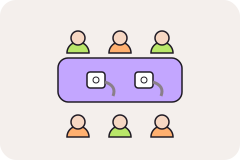
Suggested setup: tables. Write 13 categories on the sheet: ones to sixes (add those dice), three and four of a kind (add all dice), full house 25, small straight 30, large straight 40, five of a kind 50, and chance (add all dice).
Write 13 categories on the sheet: ones to sixes (add those dice), three and four of a kind (add all dice), full house 25, small straight 30, large straight 40, five of a kind 50, and chance (add all dice).
On a turn, roll all five dice, keep any you like and reroll the rest, up to three rolls in all.
Write the result in one empty category, or a zero if nothing fits.
Play until every category is filled.
Add up the totals; the highest wins.
Without a printer: Rule a sheet of paper into 13 rows with a column for each player.
A small target ball and two to four larger balls per player or team, in different colors
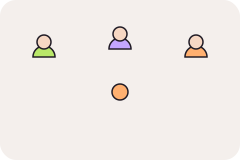
Suggested setup: spread out. One player throws the small target ball onto the lawn.
One player throws the small target ball onto the lawn.
Players take turns rolling or tossing their balls to stop as close to it as possible.
When all balls are thrown, the side with the closest ball scores a point for each of its balls nearer than the other side's best.
The scoring side throws the target ball to start the next round.
The first side to 12 points wins.
Dizzy bat race
Players
2 teams of 3 or more
Minutes
10
Ages
12 and up
You need
Two plastic bats or pool noodles, and a soft, open lawn
Suggested setup: teams. Each player runs to a bat about 30 feet away, rests their forehead on the handle with the other end on the ground, and spins around it 10 times.
Each player runs to a bat about 30 feet away, rests their forehead on the handle with the other end on the ground, and spins around it 10 times.
They then run, or wobble, back to tag the next teammate.
The first team with everyone back wins.
Keep a spotter by the bats and clear the lawn of anything to trip over.
Anyone who gets motion sick can be the spotter instead.
Blindfold obstacle guide
Players
Pairs, 4 to 20 players
Minutes
15
Ages
10 and up
You need
Blindfolds and soft obstacles such as cones, cushions and pool noodles
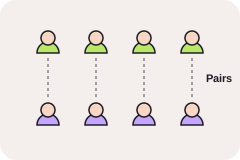
Suggested setup: pairs. Scatter the obstacles across a patch of lawn.
Scatter the obstacles across a patch of lawn.
One partner wears a blindfold; the other stands outside the course and guides with words only.
The walker crosses the course without touching an obstacle.
Each touch adds five seconds to the pair's time.
Send several pairs at once to make it louder and harder, then swap roles.
Pool party games
Marco Polo
Players
4 to 15
Minutes
15 to 20
Ages
6 and up, confident in water
You need
A pool, with an adult watching the water at all times
Suggested setup: spread out. Agree the edges of the play area first, in water where every player can stand.
Agree the edges of the play area first, in water where every player can stand.
One player is Marco and keeps their eyes closed.
Marco calls Marco, and everyone else must answer Polo.
Marco follows the voices and tries to tag someone.
The tagged player becomes the next Marco.
Sharks and minnows
Players
6 to 20
Minutes
15 to 20
Ages
7 and up, confident swimmers
You need
A pool wide enough to cross, with an adult watching the water at all times
Suggested setup: spread out. One player is the shark in the middle; the minnows line up along one side.
One player is the shark in the middle; the minnows line up along one side.
The shark calls: fishy, fishy, cross my ocean.
The minnows swim to the other side, and any minnow the shark tags becomes a shark too.
Keep crossing until one minnow is left.
That minnow is the first shark of the next game.
Treasure dive
Players
2 to 12
Minutes
10
Ages
5 and up
You need
Sinking dive toys or rings in several colors, and an adult watching the water
Suggested setup: spread out. Toss the toys into water at a depth that suits the swimmers: standing depth for young children.
Toss the toys into water at a depth that suits the swimmers: standing depth for young children.
Give each color a point value.
On go, players dive or reach down to collect them.
Players count their points when the pool floor is clear.
Run a separate round in the shallow end for the youngest swimmers.
Beach ball relay
Players
2 teams of 3 or more
Minutes
10
Ages
6 and up
You need
Two beach balls and a pool where players can stand
Suggested setup: teams. Teams line up along one side of the shallow end.
Teams line up along one side of the shallow end.
The first player moves the beach ball across the pool without using their hands, pushing it with their head or by blowing.
At the far wall, they throw it back to the next teammate.
The first team to get every player across wins.
Cannonball splash contest
Players
3 to 15
Minutes
10 to 15
Ages
8 and up, strong swimmers
You need
The deep end of a pool where jumping is allowed, and judges on the side
Suggested setup: spread out. Check the pool's rules and depth, and jump only where it is deep enough and allowed.
Check the pool's rules and depth, and jump only where it is deep enough and allowed.
One player jumps at a time, and the next waits until the water is clear.
Judges hold up fingers from 1 to 10 for the size of the splash.
Add a round for the silliest jump.
The highest total after two rounds wins.
Floating ring toss
Players
2 to 10
Minutes
10
Ages
4 and up
You need
A floating target such as an inflatable ring or a pool noodle tied into a circle, and 5 rings
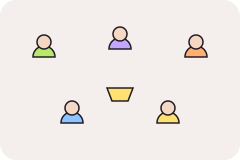
Suggested setup: circle. Float the target a few feet from the edge of the pool, or tie it in place.
Float the target a few feet from the edge of the pool, or tie it in place.
Players stand on the side or in the water and toss five rings each.
A ring that lands inside the target scores 2, and one that touches it scores 1.
Move the target farther away for older players.
Fourth of July games
Fourth of July trivia
Players
4 to 40, in teams
Minutes
20 to 30
Ages
10 and up
You need
The question set, paper and pens
Suggested setup: teams. Gather teams at the picnic tables once the food is served.
Gather teams at the picnic tables once the food is served.
Read one question at a time and give teams a minute to answer.
Each team writes one answer per question.
Reveal the answers at the end and add up the scores.
Time the last round to finish before dusk or the fireworks.
Without a printer: Read the questions from a phone; teams write on paper plates if nothing else is at hand.