17 Easter party games Egg hunts, races and table games for a family or class Easter party, plus games for adults and church groups.
Start with this one
Easter egg hunt
Players 3 to 30
Minutes 15 to 20
Ages 2 to 10
You need Plastic eggs in one color per child, and a basket or bag for each Count the eggs so each child has the same number, and give each child one color to collect. Hide toddlers' eggs in plain sight at ground level, and older children's eggs higher and in tighter spots. Mark the edge of the hunt area and any places that are off limits. All the steps and ways to adapt it Or try Clue hunt to the basket or Adult egg hunt with prize numbers .
Find a game
Your group Any size 17 2 to 5 14 6 to 12 17 13 to 30 16 More than 30 3 Time Any length 17 10 minutes or less 9 10 to 20 minutes 8 20 to 40 minutes 4 Longer 1 Runs alongside the party 1 Printer Any 17 No printer 6 Printer available 17
Show every game Group size, playing time and ages are suggestions to adapt to your group, not measurements. Anyone may pass a turn.
Egg hunts Easter egg hunt
Players 3 to 30
Minutes 15 to 20
Ages 2 to 10
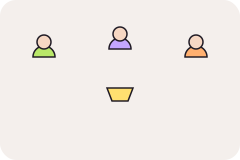
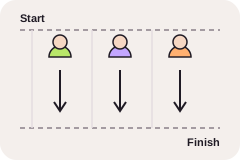
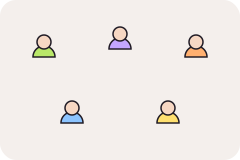
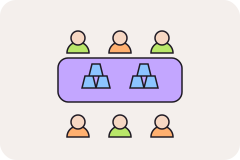
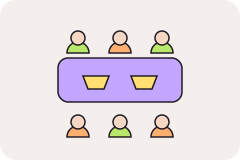
You need Plastic eggs in one color per child, and a basket or bag for each Suggested setup: spread out. Count the eggs so each child has the same number, and give each child one color to collect. Count the eggs so each child has the same number, and give each child one color to collect. Hide toddlers' eggs in plain sight at ground level, and older children's eggs higher and in tighter spots. Mark the edge of the hunt area and any places that are off limits. Start everyone together. A child who finds another color leaves it for its owner. Keep a list of hiding spots so no egg is left outside. Clue hunt to the basket
Players 1 to 10
Minutes 20 to 30
Ages 6 and up
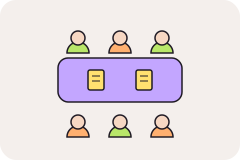
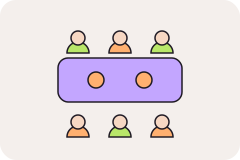
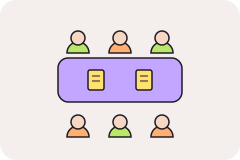
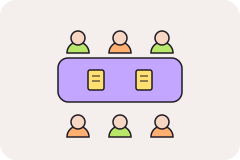
You need 8 to 12 clue cards, plastic eggs to hold them, and a hidden basket Suggested setup: tables. Plan the route first: the basket comes last, and each clue is hidden where the one before it points. Plan the route first: the basket comes last, and each clue is hidden where the one before it points. Put each clue in a plastic egg and number the eggs in order. Hand the first clue to the child or team. Each clue leads to the next egg, and the last one leads to the basket. For several children, give each a different starting clue so everyone gets to solve one. Without a printer: Write each clue on any scrap of paper, or read the first clue aloud.
For this game: Scavenger hunt riddles and hiding clues
Adult egg hunt with prize numbers
Players 6 to 30
Minutes 15 to 20
Ages Adults
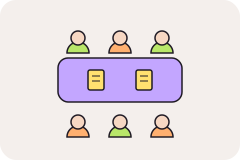
You need Plastic eggs with numbered slips inside, and a prize table with matching numbers Suggested setup: tables. Put a numbered slip in each egg. Most numbers win a small prize, and one golden egg wins the top prize. Put a numbered slip in each egg. Most numbers win a small prize, and one golden egg wins the top prize. Hide the eggs in harder places than for children: inside shoes, among books, taped under tables. Give each adult a limit, such as five eggs. Open the eggs together and claim the prizes that match. Races and outdoor games Egg and spoon race
Players 4 to 30
Minutes 10
Ages 4 and up
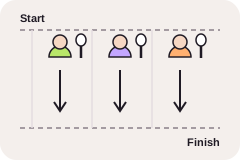
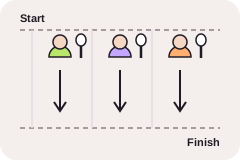
You need A spoon and a hard-boiled or plastic egg for each runner Suggested setup: relay lanes. Mark a start and a finish line on the grass. Mark a start and a finish line on the grass. Each runner balances an egg on a spoon held in one hand. If the egg falls, the runner goes back to the start. Young children can put it back where it fell. The first to cross the finish with the egg still on the spoon wins. Run it as a team relay by handing the spoon on. Egg roll race
Players 4 to 20
Minutes 10
Ages 3 and up
You need A hard-boiled egg and a long-handled spoon for each player Suggested setup: relay lanes. Line players up with an egg on the ground in front of each. Line players up with an egg on the ground in front of each. On go, they push the egg across the lawn with the spoon, never lifting it. An egg that rolls out of its lane goes back to where it left. The first egg over the finish line wins. Bunny hop sack race
Players 4 to 20
Minutes 10
Ages 4 and up
You need A pillowcase or sack for each racer Suggested setup: relay lanes. Each racer stands in a pillowcase and holds the top at the waist. Each racer stands in a pillowcase and holds the top at the waist. Racers hop like bunnies from the start line to the finish. Anyone who falls gets up and hops on from the same spot. Race on grass, and group racers by age. Egg toss
Players 6 to 30, in pairs
Minutes 10
Ages 8 and up
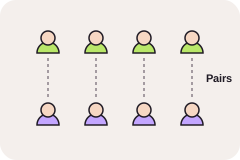
You need One raw or hard-boiled egg per pair Suggested setup: pairs. Partners face each other one step apart. Partners face each other one step apart. They toss the egg back and forth, catching it gently each time. After each catch, both step back one step. A pair whose egg cracks is out. The last pair with a whole egg wins. Play outside, and use hard-boiled eggs for a less messy round. Pin the tail on the bunny
Players 4 to 20
Minutes 10 to 15
Ages 3 to 8
You need A large bunny picture, cotton-ball tails with tape, and a blindfold Suggested setup: tables. Tape a large bunny picture to the wall at child height. Tape a large bunny picture to the wall at child height. Write each child's name on the tape of a cotton-ball tail. Blindfold one child at a time, turn them gently once, and point them toward the wall. The child sticks the tail where they think it belongs. The closest tail wins. Any child who prefers can close their eyes instead of wearing the blindfold. Without a printer: Draw the bunny on a large sheet of paper.
Bunny says
Players 5 to 30
Minutes 5 to 10
Ages 3 to 6
You need Nothing Suggested setup: spread out. The leader gives actions such as 'Bunny says hop' or 'Bunny says wiggle your nose.' The leader gives actions such as 'Bunny says hop' or 'Bunny says wiggle your nose.' Children do the action only when the command starts with 'Bunny says.' Anyone who moves on a command without it sits out one turn, then rejoins. Let children take turns being the bunny. Pass the egg basket
Players 6 to 25
Minutes 10
Ages 3 to 8
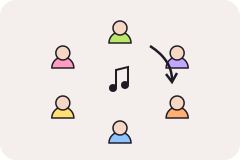
You need A basket with one plastic egg per child, each holding an action slip, and music Suggested setup: circle. Put an action slip in each plastic egg, such as hop like a bunny or flap like a chick. Put an action slip in each plastic egg, such as hop like a bunny or flap like a chick. Children pass the basket around the circle while music plays. When the music stops, the child holding it takes an egg, opens it and does the action. Play until every child has had an egg. Indoor and printable games Easter bingo
Players 4 to 30
Minutes 15 to 20
Ages 5 and up
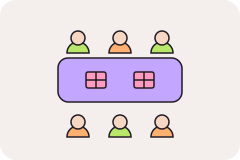
You need A different card for each player, the call list, a basket, and jelly beans or paper eggs as markers Suggested setup: tables. Hand each player a different card and a small cup of jelly beans or paper eggs. Hand each player a different card and a small cup of jelly beans or paper eggs. Cut the call list into slips and draw them out of a basket, one at a time. Players cover each word they have with a marker from their cup. The first full line wins a chocolate egg. Carry on for a full card. Without a printer: Draw 3 by 3 grids and let players fill them with words from the call list.
For this game: Easter bingo
Easter word search
Players Any number
Minutes 10 to 15
Ages 6 and up
You need A word search and a pencil for each player Suggested setup: tables. Set a puzzle at each place at the table before the meal. Set a puzzle at each place at the table before the meal. Players find the Easter words while food is served. Pair a young reader with an older child or an adult. Check finished puzzles against the answer page. Without a printer: Open the puzzle on a tablet and let children take turns finding words with a grown-up.
For this game: Easter word search
Egg halves match
Players 2 to 20
Minutes 5 to 10
Ages 2 to 5
You need 10 to 20 plastic eggs in different colors, opened into halves Suggested setup: tables. Open the plastic eggs and mix all the halves in a basket. Open the plastic eggs and mix all the halves in a basket. Children find two halves of the same color and snap them together. For older preschoolers, write a number on one half and that many dots on the other. Count the eggs together at the end. Jelly bean jar guess
Players Any number
Minutes Runs through the party
Ages All ages
You need A clear jar of jelly beans you have counted, slips and pens Suggested setup: tables. Count the jelly beans as you fill the jar, and write the number down. Count the jelly beans as you fill the jar, and write the number down. Guests write their name and guess on a slip and drop it in a box. Close guessing before dessert. The closest guess wins the jar. Easter trivia for adults
Players 4 to 30, in teams
Minutes 20 to 30
Ages 12 and up
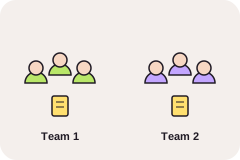
You need Easter trivia questions, an answer sheet per team and pens Suggested setup: teams. Split the group into teams of three to five. Split the group into teams of three to five. Read two rounds of questions about Easter traditions, food and history. Teams write each answer before the next question. Swap sheets to mark, then read out the scores. Without a printer: After each question, teams hold up their answer on any scrap of paper.
For this game: Easter trivia questions
Egg decorating contest
Players Any number
Minutes 30 to 45
Ages All ages
You need Hard-boiled eggs, markers, stickers, paint or dye, and paper towels Suggested setup: tables. Give everyone two eggs and a shared table of supplies. Give everyone two eggs and a shared table of supplies. Announce the categories, such as funniest, most colorful and best use of stickers. Allow 20 minutes to decorate. Everyone votes by placing a jelly bean beside their favorite in each category. For church groups Easter story egg hunt
Players 5 to 30
Minutes 20 to 30
Ages 5 and up
You need 12 numbered plastic eggs, each holding a small object and a Bible reference, and a Bible Suggested setup: spread out. Fill each numbered egg with an object and a verse reference for one part of the Easter story, such as a leaf for the entry into Jerusalem or a small stone for the empty tomb. Fill each numbered egg with an object and a verse reference for one part of the Easter story, such as a leaf for the entry into Jerusalem or a small stone for the empty tomb. Hide the eggs and let the children collect them all. Sit together and open the eggs in number order. Read each passage aloud or retell it, then ask what the object stands for. Timer and team scores Seconds per turn Turns in the session
8 turns × 60 seconds = 8 minutes of play, plus instructions and breaks.
60
Start Pause Reset
Pause whenever the group needs more time.
Teams2 3 4 5 6 Team Lime's turn
Next team Team Lime: 0
Team Lime +1 Team Lime −1 Team Violet: 0
Team Violet +1 Team Violet −1 Team Tangerine: 0
Team Tangerine +1 Team Tangerine −1 Team Sky: 0
Team Sky +1 Team Sky −1 Team Lemon: 0
Team Lemon +1 Team Lemon −1 Team Bubblegum: 0
Team Bubblegum +1 Team Bubblegum −1
More to choose from