30 Christmas party games

Games for adult and family parties, gift exchanges, office parties and kids, each with group size, time, ages and what you need. Printable games link to their cards, puzzles and questions, and a plan for a classroom Christmas party follows the games.

Updated

Group size, playing time and ages are suggestions to adapt to your group, not measurements. Anyone may pass a turn.

Party games for adults and mixed ages

Christmas charades

Players
4 to 30, in two teams
Minutes
20 to 40
Ages
6 and up
You need
Christmas prompts on folded slips, a bowl and a one-minute timer
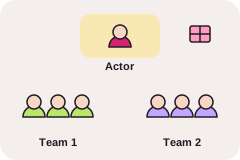
  1. Split into two teams and put the prompts in a bowl: wrapping a present, ice skating, decorating the tree, building a snowman.
  2. A player draws a prompt and acts it for their own team without speaking or mouthing words.
  3. The team has one minute to guess, and a right guess scores a point.
  4. Teams take turns, with a different actor each time.
  5. When everyone has acted once or twice, the higher score wins.

Without a printer: The actor reads each prompt privately from a phone.

Open the material: Christmas charades ideas

Christmas draw and guess

Players
4 to 20, in two teams
Minutes
20 to 30
Ages
6 and up
You need
Paper or a whiteboard, markers, cards with Christmas words and a one-minute timer
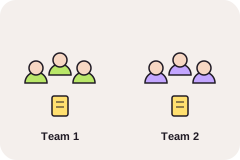
  1. Write Christmas words on the cards: sleigh, snow globe, gingerbread house, chimney, stocking, reindeer.
  2. One player takes a card and draws it for their team, with no letters, numbers or talking.
  3. The team has one minute to name it for a point.
  4. Switch to the other team, with a new artist each turn.
  5. For a faster round, both teams guess every drawing and the first right answer takes the point.

Without a printer: Write the words on scraps of paper and fold them.

Open the material: Printable drawing game cards

Guess the carol

Players
4 to 40, alone or in teams
Minutes
15 to 20
Ages
6 and up
You need
A phone or speaker with a playlist of carols and Christmas songs, paper and pens
  1. Make a playlist of 15 to 20 well-known carols and Christmas songs.
  2. Play the first five seconds of a song, or hum it.
  3. Players or teams write down the title.
  4. Reveal the title after each song and give a point for each right answer.
  5. In later rounds, play only two seconds or start from the middle of the song.

Christmas categories

Players
3 to 20
Minutes
15 to 20
Ages
9 and up
You need
Paper, pens and a two-minute timer
  1. Everyone writes the same six categories: a Christmas food, something on a tree, a winter animal, a toy, something red, and a Christmas song or film.
  2. Pick a letter at random, leaving out hard ones such as Q, X and Z.
  3. Players have two minutes to write one answer per category starting with that letter.
  4. Read the answers aloud: an answer nobody else wrote scores a point, and shared answers score nothing.
  5. Play several letters and add up the points.

Christmas memory tray

Players
2 to 30
Minutes
10
Ages
6 and up
You need
A tray, 15 to 20 small Christmas objects, a cloth, paper and pens
  1. Set out the objects on the tray: an ornament, a candy cane, a bell, a pine cone, a ribbon and so on.
  2. Show the tray for one minute, then cover it with the cloth.
  3. Players write down every object they remember.
  4. Uncover the tray and give a point for each object remembered.
  5. For a second round, remove two objects while players look away and ask which are missing.

Snowman wrap

Players
Teams of 3 or 4
Minutes
10
Ages
5 and up
You need
A roll of toilet paper per team, plus hats, scarves and paper circles for buttons
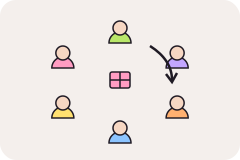
  1. Each team chooses one player to be the snowman.
  2. Start a two-minute timer while the others wrap the snowman from shoes to shoulders.
  3. Keep the face uncovered.
  4. In the last 30 seconds, add a hat, a scarf and paper buttons.
  5. The other guests vote for the best snowman.

Gift exchange games

White elephant gift swap

Players
6 to 30
Minutes
30 to 60
Ages
12 and up
You need
One wrapped gift per player within a price limit set in the invitation, and a numbered slip per player
  1. Everyone adds a wrapped gift to a central pile and draws a number.
  2. Player 1 unwraps any gift from the pile.
  3. Each next player either unwraps a new gift or steals one already opened; a player who loses a gift steals a different one or unwraps a new one.
  4. A gift is frozen after its third steal, and nobody takes back the gift just stolen from them.
  5. When the pile is empty, player 1 may make one final swap, and the game ends.

Without a printer: Write the numbers on scraps of paper and fold them.

Open the material: Printable gift exchange numbers

Left-right gift pass

Players
6 to 30
Minutes
10
Ages
5 and up
You need
One wrapped gift per player and a short Christmas story, written in advance, that uses the words left and right many times
  1. Everyone sits in a circle holding a wrapped gift.
  2. The host reads the story aloud.
  3. At every left, everyone passes the gift they hold to the left; at every right, to the right.
  4. Read faster near the end to make it harder.
  5. When the story ends, each player opens the gift in their hands.

Christmas dice gift swap

Players
6 to 20
Minutes
15 to 25
Ages
8 and up
You need
One wrapped gift per player, two dice and a timer
  1. Put all the gifts in the middle of the circle and pass two dice around.
  2. A player without a gift who rolls a double takes one from the middle; keep passing until the middle is empty.
  3. Set a timer for 5 to 10 minutes without telling anyone the time left.
  4. Keep passing the dice: now a double lets the roller take any gift from another player.
  5. When the timer rings, everyone opens the gift they hold.

Plastic wrap prize ball

Players
4 to 15
Minutes
20 to 30
Ages
6 and up
You need
A roll of plastic wrap, small prizes and wrapped candies, a bigger prize for the center, two dice, and oven mitts to make it harder
  1. Before the party, wrap the big prize in plastic wrap and keep winding, adding small prizes and candies layer by layer until you have a large ball.
  2. Sit in a circle; one player starts unwrapping while the player on their left rolls two dice.
  3. The unwrapper keeps every prize that falls out.
  4. When the roller throws a double, the ball moves to them and the dice move one seat to the left.
  5. Whoever unwraps the prize at the center keeps it, and the game ends.

Secret Santa guessing round

Players
4 to 40
Minutes
15 to 30
Ages
10 and up
You need
Gifts from a Secret Santa name draw, each with a clue on the tag instead of the giver's name
  1. When people draw names weeks ahead, ask each giver to write a clue about themselves on the tag, such as a hobby or a favorite food.
  2. At the party, the recipient reads the clue aloud and has three guesses at the giver.
  3. The giver owns up after a right guess or the third wrong one.
  4. The recipient opens the gift, and the next person reads their tag.

Open the material: Gift exchange games and simple rules

Office and large-group games

Find-someone-who bingo

Players
10 to 100
Minutes
15 to 20
Ages
12 and up
You need
A bingo card per player with a light prompt in each square, and pens
  1. Give each player a card whose squares describe people, such as likes puzzles or enjoys crafts.
  2. Players mingle and write in each square the name of a person who fits it.
  3. Each name may appear only once on a card, and anyone may pass on a question.
  4. The first player with a full line calls bingo and reads out the names for checking.
  5. Keep playing for a full card while the room is enjoying it.

Without a printer: Players draw a 4 by 4 grid and write in the prompts as the host reads them out.

Open the material: Human bingo

Paper snowball fight

Players
10 to 100
Minutes
10 to 15
Ages
10 and up
You need
A sheet of white paper and a pen per player
  1. Everyone writes an answer to the same light question, such as a favorite winter food or a snowy place they would like to see, without a name.
  2. Crumple the sheets into snowballs and give the room 30 seconds to throw them.
  3. Each player picks up one snowball and reads it aloud.
  4. The group guesses who wrote it; the writer may own up or stay anonymous.
  5. Play a second round with a new question.

Ugly sweater contest

Players
Any number
Minutes
15
Ages
All ages
You need
Paper ballots, pens and a box
  1. Announce the contest in the invitation so guests can wear or make a festive sweater.
  2. Choose several categories, such as most festive, best homemade and funniest, so more people can win.
  3. Wearers line up or walk a short catwalk.
  4. Guests vote on paper for one sweater per category.
  5. Count the ballots and announce a winner for each category.

One-handed gift wrap race

Players
Pairs, any number
Minutes
10
Ages
10 and up
You need
For each pair: a box, wrapping paper, tape, scissors and ribbon
  1. Partners stand side by side; one may use only the left hand and the other only the right.
  2. Their other hands stay behind their backs.
  3. Start a two-minute timer.
  4. Together they wrap the box and tie the ribbon.
  5. When time is up, a judge or the guests pick the neatest parcel.

Guess how many

Players
Any number
Minutes
Runs through the party
Ages
All ages
You need
A clear jar filled with a counted number of wrapped candies, jingle bells or small ornaments, slips of paper and pens
  1. Count the items as you fill the jar and write the number on a hidden card.
  2. Set the jar near the entrance with the slips and pens.
  3. Each guest writes their name and one guess.
  4. Near the end of the party, read out the real number.
  5. The closest guess wins the jar; settle a tie with a coin toss.

Holiday scavenger hunt on camera

Players
4 to 30 on a video call
Minutes
10 to 15
Ages
All ages
You need
A video call and a list of things people are likely to have at home
  1. The host calls out an item: something red, a holiday mug, a greeting card, a sock, something that sparkles.
  2. Players run to find it and hold it up to the camera.
  3. The first person to show it scores a point.
  4. Give an extra point for the funniest find in each round.
  5. After 10 to 15 items, the highest score wins.

Open the material: How to run a game on a video call

Kids and classroom games

Candy cane hunt

Players
Any number
Minutes
10 to 15
Ages
3 to 10
You need
Wrapped candy canes, or paper ones where food is not allowed, and a bag per child
  1. Count the candy canes and hide them where the children can reach, lower down for the youngest.
  2. Tell each child how many they may collect, so everyone finds some.
  3. Hide one specially marked cane that wins a small prize.
  4. Say go and let the children search.
  5. Check the count at the end so nothing is left behind.

Reindeer ring toss

Players
2 teams of 2 to 6
Minutes
10 to 15
Ages
4 and up
You need
An antler headband, 6 rings such as pool rings or paper plates with the centers cut out, and tape to mark a line
  1. One player per team wears the antlers and stands about 6 feet from the line.
  2. Teammates take turns tossing the rings toward the antlers.
  3. The wearer may move their head to catch rings but may not use their hands.
  4. Count the rings caught in one minute.
  5. Swap the wearer and play again; the team with more rings wins.

Santa says

Players
4 to 30
Minutes
10
Ages
3 to 8
You need
Nothing, or a Santa hat for the leader
  1. The leader gives actions, such as Santa says pat your tummy and say ho ho ho.
  2. Players do only the actions that start with Santa says.
  3. A player who follows an action without Santa says sits out for one round, then rejoins.
  4. Mix in Christmas actions: fly like a reindeer, wrap a present, shiver like a snowman.
  5. Let a child take a turn as Santa.

Christmas four corners

Players
10 to 30
Minutes
10 to 15
Ages
5 to 11
You need
Four signs with Christmas pictures or words, one for each corner of the room
  1. Put a sign in each corner: tree, star, stocking and bell.
  2. One player closes their eyes and counts slowly down from 10.
  3. Everyone else tiptoes to a corner and stays there.
  4. With eyes still closed, the counter names a corner, and the players in it sit down in the middle.
  5. Repeat until one player is left, who becomes the next counter.

One-minute Christmas challenges

Christmas tree cup stack

Players
One at a time, any number
Minutes
1 per turn
Ages
6 and up
You need
10 green plastic cups per station and a timer
  1. Put the cups in a single stack at each station.
  2. On go, the player builds a pyramid of four, three, two and one cups, shaped like a tree.
  3. They then stack it back into a single pile.
  4. The fastest time wins, or count how many trees a player builds in one minute.

Jingle bell shake

Players
2 to 6 at a time
Minutes
1 per round
Ages
6 and up
You need
An empty tissue box per player with 6 jingle bells or ping pong balls inside, and a belt or ribbon to tie it on
  1. Tie a box to the back of each player's waist, with the opening facing out.
  2. On go, players wiggle and jump to shake the bells out without using their hands.
  3. The first to empty the box, or the one with the fewest left after a minute, wins.

Oven mitt unwrap

Players
2 to 4 at a time
Minutes
1 per round
Ages
8 and up
You need
A small box wrapped with plenty of tape for each player, and a pair of oven mitts per player
  1. Put a tiny prize in each box and wrap it with lots of tape.
  2. Players put on the oven mitts.
  3. On go, they have one minute to unwrap the box completely.
  4. The first to hold up the prize wins; if nobody finishes, the most unwrapped box wins.

Printable games and quizzes

Christmas bingo

Players
3 to 40
Minutes
20 to 30
Ages
5 and up
You need
A different bingo card per player, the call list, and counters such as buttons or small candies
  1. Print a different card for each player and one call list for the caller.
  2. The caller reads the items in a random order and ticks each one off.
  3. Players cover each called item on their card.
  4. The first to fill a line calls bingo and reads the line back for checking.
  5. Play on for two lines or a full card if you want a longer game.

Without a printer: Players draw a 4 by 4 grid and fill it with words the caller reads from the list, each in their own order.

Open the material: Christmas bingo cards

Christmas trivia quiz

Players
2 to 40, in teams of 2 to 6
Minutes
30 to 45
Ages
10 and up
You need
The question set, an answer sheet per team and pens
  1. Split into teams and give each an answer sheet.
  2. The host reads 10 questions per round, repeating each one.
  3. Teams write one answer per question, without phones.
  4. At the end of a round, teams swap sheets and mark each other's as the host reads the answers.
  5. Play three rounds and add up the scores.

Without a printer: The host reads the questions from a phone, and teams write their answers on any paper.

Open the material: Christmas trivia questions

Christmas quiz board

Players
2 to 5 teams
Minutes
30 to 45
Ages
8 and up
You need
A TV, laptop or projector to show the board
  1. Open the board on a screen everyone can see and name the teams.
  2. The first team picks a category and a point value.
  3. The team talks it over and gives one answer.
  4. Reveal the answer and add the points to that team's score.
  5. Teams take turns until the board is empty.

Christmas word search race

Players
1 to 30, alone or in pairs
Minutes
10 to 15
Ages
7 and up
You need
A copy of the puzzle and a pencil per player or pair
  1. Hand out the same puzzle face down.
  2. On go, players turn it over and circle the words from the list.
  3. The first to find every word calls out and shows their sheet.
  4. Check the sheet against the answer key before naming a winner.
  5. For a timed round, stop after 10 minutes and count the words found.

Without a printer: Show the puzzle on a TV or tablet; players call out a word and point to where it is.

Open the material: Christmas word search

Christmas riddle round

Players
2 to 30
Minutes
15
Ages
6 and up
You need
The riddle list, and paper for each team
  1. Read a riddle aloud, twice.
  2. Teams talk quietly and write their answer.
  3. Reveal the answer and give a point for each right one.
  4. Play 10 riddles, then total the points.

Without a printer: Read the riddles from a phone.

Holiday would you rather

Players
3 to 40
Minutes
10 to 20
Ages
6 and up
You need
The question list
  1. Name one side of the room for each choice.
  2. Read a question aloud.
  3. Players walk to the side they choose; seated players can point instead.
  4. Ask one or two volunteers on each side to explain their choice.
  5. Anyone may pass on a question.

Without a printer: Read the questions from a phone.

Open the material: Holiday would you rather questions

Christmas classroom party plan

Use this plan to fit the games into a school event. Times below are a suggested schedule to adapt to the room.

1. Confirm the party boundary in writing

Record the exact start time, finish time, room, supervising adults, approved food rule, photo rule, and cleanup deadline. Ask the responsible administrator or class teacher which Christmas references are allowed and whether any student needs an alternative way to take part.

If any answer is missing on the morning of the party, use the narrower plan: no food, no photos, no student gifts, and classroom materials only. Do not fill a policy gap with a guess.

2. Choose one outcome and three event parts

Write one sentence that defines success, such as: “Students will complete one shared Christmas display and leave every table ready for lessons.” Put only three parts on the board:

  1. a whole-class arrival task;
  2. a small-group making or solving block;
  3. a whole-class finish.

Cut any activity that does not serve one of those parts. If the available block is 42 to 56 minutes, reserve 8 to 12 minutes for arrival, 21 to 29 minutes for group work, and 9 to 15 minutes for the finish and cleanup. Treat the ranges as boundaries, not quotas.

3. Set the participation and theme rule

Tell students: “You may join the Christmas theme, use a winter version of the same task, or take a classroom helper role. All three routes count.” Put the three routes on the board before anyone chooses. CAST’s UDL Guidelines support learner choice and varied methods of response.

Do not use knowledge of a religious story, family celebration, gift tradition, or holiday meal as the price of entry. If a student changes routes during the party, move their name on the job list without asking them to explain.

4. Remove food as an improvisation

Use a nonfood plan unless the school has already authorized food and supplied its food-allergy procedure. If food is authorized, follow the written plan and named staff responsibilities. Do not rely on a classmate’s memory, remove a known allergen only from one plate, or add a surprise treat. CDC school guidance tells staff to use the school food-allergy plan and avoid known allergens in classroom parties, holidays, and activities.

Put approved food, if any, into one scheduled segment. Stop food service before materials move between tables, then follow the school’s hand-cleaning and surface-cleaning procedure.

5. Make uneven groups from the attendance list

Use the students who are present, not the normal register. For 27 students, for example, make groups of 4, 5, 5, 6, and 7. No one size controls most of the room, and late arrivals can be added without rebuilding every group.

Assign each group a first reader, materials lead, recorder, checker, and reset lead. In larger groups, add a second checker or materials partner. Change at least two jobs halfway through. If one student completes two other people’s jobs, pause that group and restore the job order.

6. Prepare one tray or envelope per group

Give every group a complete set before students enter. Label it with the group symbol and list exactly what must return. Use familiar classroom items: paper, pencils, reusable counters, board markers, and pre-approved craft materials.

Add one “stuck” card with this instruction: “Circle the blocked part and ask the checker to choose: simplify it, ask the teacher one question, or move to the next part.” If a group asks for a missing item, check its container first. Do not open a general supply cupboard during the timed block.

7. Start with work already visible

Put a silent arrival prompt on the board, such as: “Choose one word you want the class celebration to feel like, then write or draw it on your table slip.” Students who do not use the Christmas route can answer for the winter event or the class community.

Begin the timer when the first student enters. After 6 to 9 minutes, collect one slip from each table and read a varied sample. If fewer than half the tables have started after three minutes, stop and model one response. Do not repeat the whole set of party instructions over the room.

8. Give the operating script before materials open

Say what students will do, how they will ask for help, what signal ends a round, and what “reset” looks like. Demonstrate the reset: tools down, loose pieces in the tray, recorder holds the work, everyone looks at the board.

Ask one student to repeat the help route and a different student to repeat the reset. If either cannot, demonstrate again. Open the materials only after both directions are accurate.

9. Run one group block with two checkpoints

At the first checkpoint, inspect only participation and progress. If one person is doing all the writing, switch the recorder. If a group has not completed its first action, remove one optional part and give it a two-choice next step.

At the second checkpoint, announce the finish requirement. Groups must choose what they will complete and what they will leave out. If two groups miss the attention signal, stop the timer, reset the whole room, and restart with a shorter remaining target. Do not compete with the noise by raising your voice.

10. Close through jobs, not a cleanup plea

Call jobs in order: materials leads count items, recorders place work in the named location, reset leads clear tables, and checkers compare the tray with its return list. Release no table on appearance alone.

Finish with one class action lasting 3 to 6 minutes: read selected arrival words, add one completed piece from each group to the shared display, or let each group name one decision it made. Stop at the announced time even if optional decoration remains. Photograph work only if the written rule permits it.

Run a 48-minute party from one room card

Say first: “Today has three parts: an arrival task, one group block and a class finish. You may use the Christmas route, the winter route or a helper job. All three count. Your tray stays closed until the reset and help routes work in our practice. We finish at [time], even if optional work remains.”

Time Teacher action
0 to 8 minutes Run the visible arrival task while students enter. Model one response if fewer than half the tables begin within three minutes.
8 to 12 minutes Read the operating script, demonstrate help and reset, and ask two different students to show those routes.
12 to 31 minutes Open trays and run the group block. Check participation first, then progress.
31 to 39 minutes Give the finish requirement, close optional work and reset every tray from its return list.
39 to 48 minutes Complete one class finish, check tables by job and stop at the written time.

If a group finishes early, its checker compares the work with the finish requirement and the group begins its tray count. It receives no extra scored task. This plan has no team winner, so equal amounts of completed work are not a tie to break. If a factual answer is disputed, mark the item and use the approved lesson source after the timed block. If the source does not settle the wording, void the item. If a creative choice is disputed, accept every result inside the printed condition.

Printable Christmas classroom party checklist

  • The exact party start and finish times are written down.
  • The supervising adults and their roles are named.
  • The school’s food rule has been confirmed.
  • The school’s photo rule has been confirmed.
  • Christmas, winter, and helper participation routes are on the board.
  • The party has one written success sentence.
  • Arrival, group work, and finish are the only three event parts.
  • Food is omitted or covered by the school’s written food-allergy procedure.
  • Groups are based on the students actually present.
  • Group sizes are uneven and no size covers most groups.
  • Every student has a named first job.
  • At least two jobs will change halfway through.
  • Every group container has a complete return list.
  • A help route and reset signal have been demonstrated.
  • Early finish, equal result, and disputed-answer rules are on the room card.
  • Two checkpoints are marked on the host’s timer.
  • The final cleanup is assigned by job.
  • Every table is checked against its return list.
  • The closing action fits before the written finish time.

Sources

Plan the round and team scores

8 turns × 60 seconds = 8 minutes of play, plus instructions and breaks.

60

These are adjustable house rules. Pause whenever the group needs more time.

Team 1: 0

Team 2: 0